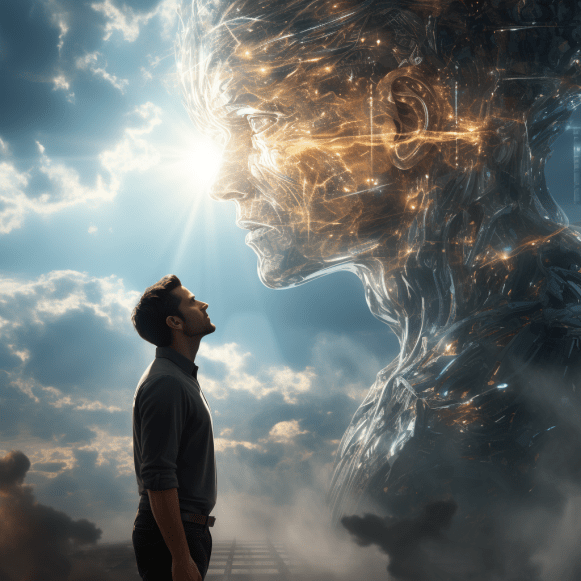
The profound question of whether AI can contribute to our understanding of consciousness is a topic of immense curiosity and debate. The capabilities of AI, such as advanced data processing, pattern recognition, and machine learning, hold promise in shedding light on the enigmatic realm of consciousness.
AI’s ability to analyze vast amounts of data and identify complex patterns could potentially unveil correlations between brain activities and conscious experiences. For instance, AI-driven simulations and models might simulate brain functions to simulate various conscious states, helping us comprehend how thoughts, emotions, and perceptions emerge from neural processes.
However, it’s important to note that while AI can aid in processing and analyzing data, true consciousness remains a philosophical and scientific puzzle that goes beyond mere data interpretation. The “hard problem” of consciousness, as posed by philosopher David Chalmers, questions how and why physical processes give rise to subjective experiences. AI, at its core, lacks subjective awareness, making it challenging to fully grasp the subjective aspects of consciousness through its capabilities alone.
Exploring the Relationship Between AI and Consciousness
AI’s impact on consciousness research extends beyond the theoretical. Researchers are developing AI-assisted tools that enhance brain imaging and decoding techniques, allowing us to study brain activity with unprecedented precision. By integrating AI algorithms into neuroimaging processes, scientists can decipher brain patterns associated with specific mental states, paving the way for a deeper understanding of consciousness-related phenomena.
Moreover, AI-driven cognitive models are being developed to simulate aspects of human cognition. These models provide insights into cognitive processes, such as memory, decision-making, and problem-solving, which are closely intertwined with conscious experiences. By refining these models, researchers hope to gain valuable insights into the relationship between cognitive functions and consciousness.
Ethical Considerations and Challenges
As we tread further into the realm of AI-driven consciousness research, ethical considerations come to the forefront. Privacy concerns related to the collection and analysis of personal brain data raise important questions about consent, data ownership, and potential misuse of information. Striking a balance between scientific progress and individual rights is imperative to ensure responsible and ethical AI research in the realm of consciousness.
Additionally, AI’s limitations must be acknowledged. While AI can simulate cognitive processes, it lacks genuine self-awareness. Consciousness is not just about processing information; it involves subjective experience, emotions, and self-reflection. AI’s inability to have conscious experiences hinders its complete understanding of this intricate phenomenon.
The Future Landscape: Possibilities and Prospects
The synergy between AI and consciousness research holds immense promise for the future. By leveraging AI’s computational power, researchers can accelerate the analysis of complex neural data and uncover hidden correlations. This, in turn, could lead to breakthroughs in understanding brain disorders, consciousness-altering substances, and the fundamental nature of conscious existence.
Furthermore, AI-powered simulations might enable us to explore altered states of consciousness in a controlled environment. This could have implications not only for scientific research but also for therapeutic applications in treating conditions such as depression, anxiety, and post-traumatic stress disorder.
AI’s Ability to Distinguish Linear from Nonlinear
Among the intriguing capabilities AI brings to consciousness research is its potential to distinguish between linear and nonlinear patterns. Linear patterns are relatively straightforward and follow a predictable trajectory. Nonlinear patterns, on the other hand, are complex and often involve intricate interactions and feedback loops.
AI’s prowess in recognizing nonlinear patterns could be instrumental in understanding the intricacies of consciousness. The brain, with its billions of interconnected neurons, operates in a nonlinear manner, giving rise to the rich tapestry of thoughts, emotions, and perceptions that constitute consciousness.
Imagine AI analyzing neural data and identifying nonlinear patterns that correspond to specific conscious experiences. This could lead to a deeper understanding of how different neural pathways interact to generate thoughts and emotions. By deciphering these nonlinear dynamics, we might inch closer to comprehending the fundamental mechanisms of consciousness.
Final Thoughts
The intertwining of AI and consciousness research is a captivating journey into the unknown. While AI holds remarkable potential to augment our understanding of consciousness, it cannot replicate the full spectrum of conscious experiences. As technology evolves and ethical frameworks adapt, we stand on the brink of uncovering unprecedented insights into the enigma of consciousness, marking an exciting chapter in human exploration.
 Powerbuilding Digital