
Fitness / Motivation / Technology & A.I / Crypto

Welcome to Edition 110 of the Powerbuilding Digital Newsletter—your weekly space to grow stronger, think sharper, and stay connected to what’s next. Whether you’ve been part of this journey since the early editions or you’re reading for the very first time, this community is built to help you keep progressing across body, mind, and future-focused knowledge.
Here’s what we’re covering this week:
- Fitness Info & Ideas
Straightforward training strategies and recovery insights to help you keep momentum steady and results consistent. - Motivation & Wellbeing
Practical mindset tools and daily disciplines to help you stay focused, energized, and resilient when life demands more of you. - Technology & AI Trends
The latest developments in artificial intelligence and digital tools—broken down into what’s useful, what’s real, and what’s worth paying attention to. - Crypto & Digital Asset Trends
Beyond speculation, we highlight apps, platforms, and blockchain use cases that are shaping how value moves in the digital age.
Edition 110 is about consistency—showing up each week, stacking progress, and moving forward with clarity. Let’s lock in and keep building together.
Fitness
Strength Training vs. Powerbuilding: Which Is Best for You?

In today’s fitness world, lifters are often faced with a tough choice: focus on pure strength or adopt a powerbuilding approach that blends strength and bodybuilding. Both paths can build muscle and power, but the priorities—and the results—are different.
This article will break down the science, benefits, and drawbacks of strength training vs. powerbuilding, and help you decide which is best for your goals.
What Is Strength Training?
Strength training is a systematic approach designed to maximize the amount of weight you can lift in foundational barbell movements: squat, deadlift, bench press, and overhead press.
- Primary goal: Increase maximal strength
- Programs: Starting Strength, 5×5, Wendler 5/3/1
- Training style: Lower reps, heavier loads, longer rest periods
What Is Powerbuilding?
Powerbuilding is a hybrid training style that combines powerlifting’s strength focus with bodybuilding’s muscle-building emphasis.
- Primary goal: Get strong and build muscle size
- Programs: PHUL (Power Hypertrophy Upper Lower), PPL Powerbuilding splits
- Training style: Mix of heavy compound lifts and high-volume accessory work
The Core Differences Between Strength Training and Powerbuilding
Goals
- Strength training: Maximize 1-rep max (performance-based)
- Powerbuilding: Maximize both strength and aesthetics (balanced approach)
Training Splits and Volume
- Strength training: Full-body or low-frequency splits, 3–4 days/week, low-to-moderate volume
- Powerbuilding: Upper/lower or push/pull/legs, 4–6 days/week, high volume
Exercise Selection
- Strength training: Squat, bench, deadlift, overhead press, accessory lifts for weak points
- Powerbuilding: Same compounds plus targeted hypertrophy lifts (curls, lateral raises, leg extensions)
Nutrition and Recovery
- Strength training: Performance-driven nutrition, often higher calories to support CNS recovery
- Powerbuilding: Focus on calorie surplus with macro balance for size and strength
The Science Behind Strength vs. Hypertrophy
- Strength: Best developed with high intensity (75–95% 1RM), low reps (1–5), and longer rest (3–5 minutes)
- Hypertrophy: Optimized with moderate intensity (65–85% 1RM), moderate reps (6–12), and shorter rest (60–120 seconds)
Powerbuilding leverages both rep ranges to target neurological adaptation (strength) and muscle fiber growth (size).
Benefits of Strength Training
- Builds raw power and maximal lifts
- Improves bone density and joint integrity
- Teaches discipline and precise technique
- Ideal for athletes in strength-focused sports
Benefits of Powerbuilding
- Builds strength and aesthetics together
- Higher training variety keeps motivation high
- Greater hypertrophy → bigger muscle size
- Balanced approach avoids extremes
Drawbacks of Strength Training
- Lower total volume → slower muscle growth
- Risk of overuse injuries from heavy barbell focus
- Progress may feel slower for those chasing “looks”
Drawbacks of Powerbuilding
- Training sessions are longer and more taxing
- Recovery demands are higher
- Progression may be slower in maximal strength compared to pure strength programs
Who Should Choose Strength Training?
Strength training is best if you:
- Want to compete in powerlifting or weightlifting
- Care about strength numbers more than appearance
- Have limited time for longer workouts
- Prefer minimalistic, barbell-focused programs
Who Should Choose Powerbuilding?
Powerbuilding is best if you:
- Want to look muscular and be strong
- Enjoy longer, more varied training sessions
- Aren’t tied to a competition sport
- Thrive on higher training volume
Example Strength Training Program (3 Days/Week)
Day 1
- Squat: 5×5
- Bench Press: 5×5
- Barbell Row: 5×5
Day 2
- Deadlift: 5×5
- Overhead Press: 5×5
- Pull-Ups: 3xAMRAP
Day 3
- Squat: 3×5 (lighter)
- Bench Press: 3×5 (lighter)
- Power Clean: 5×3
Example Powerbuilding Program (4 Days/Week Upper/Lower Split)
Day 1 – Upper (Power Focus)
- Bench Press: 4×5
- Barbell Row: 4×5
- Overhead Press: 3×6
- Weighted Pull-Ups: 3×6
Day 2 – Lower (Power Focus)
- Squat: 4×5
- Deadlift: 3×5
- Romanian Deadlift: 3×8
- Hanging Leg Raise: 3×12
Day 3 – Upper (Hypertrophy Focus)
- Incline Dumbbell Press: 4×10
- Cable Row: 4×12
- Lateral Raise: 3×15
- Bicep Curl: 3×12
- Tricep Pushdown: 3×12
Day 4 – Lower (Hypertrophy Focus)
- Leg Press: 4×12
- Bulgarian Split Squat: 3×12
- Hip Thrust: 3×12
- Calf Raises: 4×15
Common Mistakes in Both Approaches
- Neglecting recovery and sleep
- Poor nutrition (undereating protein or calories)
- Ego lifting (prioritizing weight over form)
- Program hopping without giving results time to show
Can You Combine Strength Training and Powerbuilding?
Yes—many lifters start with strength foundations, then transition into powerbuilding for a balance of size and strength. Some programs even cycle between pure strength and hypertrophy blocks.
Which Is Best for You?
- Choose strength training if you care most about numbers, performance, and raw power.
- Choose powerbuilding if you want both muscle size and strength, and you’re willing to put in more time and volume.
Ultimately, the best program is the one you can stick with consistently, aligned with your goals and lifestyle.
Sources
- Schoenfeld, B. J. (2010). The mechanisms of muscle hypertrophy.
- Zatsiorsky, V. M., & Kraemer, W. J. Science and Practice of Strength Training.
- NSCA Guidelines on Strength and Hypertrophy Training.
- Journal of Strength and Conditioning Research – Strength vs. Hypertrophy Protocols.
Motivation
Build Your Inner Temple: A Guide to Strengthening Mind, Body, and Spirit

Every temple is built for one reason: to house what is sacred. The question is, what are you housing inside yourself?
Your mind, your body, and your spirit form your true temple. It isn’t built in a day. It isn’t built by accident. It’s built brick by brick—through discipline, boundaries, resilience, and devotion to what matters most.
The world outside is loud, demanding, and unstable. But your inner temple can stand unshaken—if you build it with intention.
What It Means to Build Your Inner Temple
Building your inner temple is about creating a structure within yourself that no chaos can break. It’s alignment of:
- The body: strong, resilient, cared for
- The mind: clear, disciplined, focused
- The spirit: grounded in values and meaning
It’s a commitment to strength that isn’t just physical—it’s total.
The Foundation: Self-Discipline
No structure stands without a foundation. Your foundation is discipline.
- Keep promises to yourself, even when no one’s watching.
- Set daily rituals that anchor your life.
- Recognize that comfort is the enemy of progress.
Discipline is not punishment. Discipline is devotion—to the life you claim you want.
The Pillars: Values That Hold You Up
Your temple is only as strong as the pillars holding it up. Your values are those pillars.
Ask yourself:
- What do I stand for, no matter what?
- Which values guide my choices when things get hard?
Integrity, courage, growth, loyalty—whatever your pillars are, they keep the roof from caving in when life storms.
The Walls: Boundaries That Protect You
Without walls, a temple is vulnerable. Your walls are your boundaries.
- Say no to what steals your peace.
- Limit who and what gets access to your energy.
- Protect your time as if it were sacred—because it is.
Walls don’t make you cold—they keep your sacred space safe.
The Fire Within: Training the Body
A weak body cannot carry a strong mind forever. Physical training is non-negotiable.
- Strength training builds resilience
- Conditioning sharpens endurance
- Mobility preserves longevity
Your body is the vessel of your temple. Treat it with strength and respect.
The Quiet Sanctuary: Training the Mind
A temple is not just stone—it’s silence. Your mind needs the same.
- Daily meditation or mindfulness to quiet noise
- Journaling to process thought and emotion
- Reading to expand perspective
A trained mind doesn’t break—it bends, adapts, and returns stronger.
The Roof: Spiritual Grounding and Perspective
The roof of your temple shelters you. Spirit does the same. Whether through faith, philosophy, or a higher purpose, your spirit connects you to meaning bigger than the daily grind.
Daily Rituals That Fortify Your Inner Temple
- Morning stillness (meditation or journaling)
- Physical training (strength, sweat, or stretch)
- Reflection before sleep (gratitude, lessons, release)
Rituals are bricks. Small daily acts build massive, lasting walls.
The Enemies of Your Inner Temple
- Distraction: steals focus
- Fear: paralyzes growth
- Chaos: disrupts alignment
Each enemy must be faced with awareness and cut off at the gate.
Lessons From Ancient Philosophies
- Stoicism: Control what you can, accept what you can’t
- Buddhism: Peace is found in detachment and awareness
- Samurai Code: Honor and discipline as sacred duties
Different cultures, same truth: your temple is built through discipline and purpose.
How to Rebuild After Collapse
Temples fall. Sometimes we burn out, lose ourselves, or let our walls crumble. The key is to rebuild stronger. Begin again, one brick at a time.
Long-Term Rewards of Living from the Inner Temple
- Calm in chaos
- Strength in adversity
- Clarity in choices
- Fulfillment in daily life
Your temple becomes your anchor, no matter what storms rage outside.
You Are the Architect of Your Strength
No one else can build your inner temple. The world won’t hand you peace or strength—you have to construct it. Every rep, every boundary, every act of discipline is a brick.
Stand tall. Build with intention. And when life presses in, your temple will hold.
Technology & A.I
Arm Launches Lumex AI-Optimized Chips for Mobile Devices

Arm Holdings has unveiled Lumex, its next-generation chip architecture designed to bring advanced artificial intelligence directly to mobile devices such as smartphones and wearables.
AI on-device without the cloud
The Lumex lineup introduces four chip variations, ranging from energy-efficient models for wearables like smartwatches to high-performance versions capable of running large AI models on premium smartphones without relying on cloud computing.
Chris Bergey, Arm’s senior vice president and general manager, said the push reflects how AI has become a baseline expectation across devices. “AI is becoming pretty fundamental… whether it’s real-time interactions or use cases like AI translation,” Bergey explained.
Integrated designs for faster adoption
The Lumex family is part of Arm’s Compute Subsystems (CSS) business, which provides chipmakers with more complete, ready-to-use designs for faster integration into new products. Alongside its CSS efforts, Arm continues to expand its presence in both mobile and data center markets, positioning Lumex as part of its broader revenue growth strategy.
The company also confirmed ongoing investments in exploring in-house chip development, supported by recent hires of key industry talent.
Built on 3-nanometer technology
Lumex is optimized for advanced 3-nanometer manufacturing nodes, including those offered by TSMC. Apple’s latest iPhone chips, also announced this week, use TSMC’s 3nm process — highlighting the shift toward smaller, more powerful nodes in the industry.
Senator Ted Cruz Proposes AI Regulatory Sandbox Bill

Republican Senator Ted Cruz has introduced legislation that would allow artificial intelligence companies to apply for temporary exemptions from certain federal regulations in order to test and develop new technologies.
Aimed at boosting U.S. competitiveness
Cruz, who chairs the Senate Commerce Committee, unveiled the proposal during a subcommittee hearing focused on lowering barriers for U.S. tech firms competing with China. The bill would create a “regulatory sandbox” where companies could request exemptions lasting up to two years, provided they outline potential risks and explain mitigation plans.
“A regulatory sandbox is not a free pass. People creating or using AI still have to follow the same laws as everyone else,” Cruz said.
Industry support and opposition
Major AI companies, including OpenAI, Google, and Meta, have urged the Trump administration to reduce regulatory obstacles. The White House Office of Science and Technology Policy (OSTP) has already committed to gathering public input on regulatory hurdles.
However, consumer advocates raised concerns. Public Citizen criticized the proposal, arguing it would “treat Americans as test subjects,” particularly since the bill allows OSTP to override an agency’s denial of an exemption.
State vs. federal regulation
The legislation does not preempt state-level rules, a key demand from the tech sector. Earlier efforts to impose a 10-year moratorium on state AI regulation failed in the Senate by a 99–1 vote in July.
States have already passed a range of AI laws:
- California bans unauthorized deepfakes in political ads and requires healthcare disclosures when AI is used in patient interactions.
- Colorado passed legislation against AI-driven discrimination in employment, housing, and banking, now set to take effect in 2026.
- Several states criminalize AI-generated sexually explicit images made without consent.
At the hearing, OSTP director Michael Kratsios said state laws pose “very anti-innovation regulations” and suggested Congress revisit whether federal law should override them.
Next steps
The bill must pass both chambers of Congress before becoming law. If approved, it would establish a new pathway for AI firms to experiment under lighter federal oversight, while the broader debate over balancing innovation and consumer protection continues.
OpenAI to Launch First In-House AI Chip With Broadcom

OpenAI will debut its own artificial intelligence chip next year as the company looks to secure computing power for its models and reduce dependence on Nvidia hardware.
The chip is being co-designed with U.S. semiconductor firm Broadcom, according to multiple people familiar with the partnership. Broadcom chief executive Hock Tan referenced a “new customer” committing to $10 billion in orders during an earnings call last week. Shares in Broadcom rose 9.4% following the news, lifting its market capitalization to $1.6 trillion.
OpenAI’s initiative mirrors the strategy of major tech companies such as Google, Amazon, and Meta, which have all developed specialized chips for AI workloads. Demand for computing infrastructure has surged as training and operating large-scale AI models requires vast resources.
Sources said the new chips will be used internally by OpenAI rather than offered to external customers. The company began working with Broadcom in 2023, but a clear production timeline had not been confirmed until now.
Broadcom reported earnings above Wall Street estimates and said the deal will provide “immediate and fairly substantial demand,” with shipments beginning in 2026. Analysts expect Broadcom’s custom chip unit to outpace Nvidia’s growth by 2026, though Nvidia remains the market leader in AI hardware.
OpenAI CEO Sam Altman has repeatedly emphasized the need for greater compute resources. The company was one of the earliest adopters of Nvidia’s GPUs and continues to consume large volumes of its hardware. In August, Altman said OpenAI would double its compute fleet within five months to meet the requirements of GPT-5, its latest large language model.
ThinkAnalytics Unveils ThinkMetadataAI to Transform Video Search and Personalization

ThinkAnalytics has announced ThinkMetadataAI, a new agentic AI-powered tool designed to automate metadata creation for video providers. The launch addresses one of the industry’s longstanding challenges: boosting viewer engagement by improving search, discovery, and recommendations.
Automating Metadata at Scale
ThinkMetadataAI eliminates manual tagging by generating enriched metadata across entire content catalogs, including live TV. The system supports dozens of languages and integrates seamlessly with existing metadata providers. By automating the tagging process, ThinkAnalytics says video platforms can deliver faster, higher-quality personalization without sacrificing accuracy.
The tool will be showcased at IBC, where the company will demonstrate how AI-driven tagging enhances recommendations and discovery while supporting contextual advertising and content curation.
Part of the ThinkMediaAI Platform
ThinkMetadataAI is now embedded into ThinkMediaAI, the company’s broader platform for content monetization, curation, bundling, and advertising. The platform is being deployed to all current customers and will also be available as a standalone product.
ThinkMediaAI can tailor experiences for both logged-in and anonymous viewers, such as those on FAST (free ad-supported TV) services. Personalization is triggered within a second of viewing, using contextual signals like device, location, and time of day.
Industry Impact
Peter Docherty, CTO and co-founder of ThinkAnalytics, said customer response has been “exceptional” since the rollout of ThinkMediaAI earlier this year:
“Our years of experience in AI and discovery has given us a clear lead in understanding the DNA of content. Combining this with our use of agentic AI breaks new ground and delivers rich metadata DNA unlike anything we have seen previously, ushering in a new era of viewing based on deeper personalization.”
Why It Matters
With streaming competition at an all-time high, video providers are under pressure to maximize engagement and reduce churn. ThinkAnalytics positions ThinkMetadataAI as a critical tool to deliver scalable personalization, deeper content understanding, and operational efficiencies—all key factors in keeping viewers connected.
Crypto
BlackRock Explores Tokenized ETFs as Part of Digital Asset Push

BlackRock is evaluating the launch of tokenized versions of exchange-traded fund (ETF) shares, marking another step in its effort to extend digital asset infrastructure into mainstream finance, according to a Sept. 11 Bloomberg report.
Expanding Beyond Traditional Markets
The asset manager is considering blockchain-based ETFs tied to real-world assets such as stocks, sources familiar with the planning said. The move would build on BlackRock’s $2.2 billion BUIDL tokenized money-market fund, which launched in March 2024, shortly after the debut of its spot Bitcoin ETF.
CEO Larry Fink has repeatedly argued that “every financial asset can be tokenized,” a view he emphasized again in his 2025 annual letter to investors.
Benefits of Tokenized ETFs
Tokenized ETF shares could:
- Allow trading outside of Wall Street’s traditional market hours.
- Improve global investor access to U.S.-based products.
- Create new collateral opportunities within crypto networks.
The report comes in the same week Nasdaq filed to trade tokenized stocks and ETFs on its own platform.
Regulatory and Technical Considerations
BlackRock has already tested tokenized fund shares through JPMorgan’s Kinexys infrastructure, positioning itself among early adopters of digital settlement models. Money-market funds from Franklin Templeton and BlackRock currently represent the largest category of tokenized real-world assets (RWAs), with a combined market cap of $7.4 billion as of Sept. 11.
While ETFs offer broader exposure and trading mechanics well-suited to blockchain deployment, significant hurdles remain. Current ETF settlement relies on Wall Street clearinghouses, while blockchain enables instant, 24-hour trading. Reconciling the two systems presents both technical and regulatory challenges for custodians.
A Bridge Between TradFi and DeFi
The exploration reflects how traditional finance is actively weighing blockchain’s role in improving market infrastructure. Potential benefits include faster settlement, smoother collateral flows, and broader liquidity access.
As regulatory frameworks evolve, tokenized ETFs could emerge as another critical bridge between traditional financial systems and decentralized finance (DeFi) platforms.
Kraken Launches Perpetual Futures Ahead of Potential 2026 Public Listing

Kraken has rolled out perpetual futures contracts for eligible retail clients in select jurisdictions, marking its latest expansion as the exchange prepares for a possible public listing in early 2026.
Product Expansion
The new offering, branded Kraken Perps, allows traders to speculate on asset price movements without owning the underlying tokens. Unlike traditional futures, perpetual contracts have no expiration date, enabling positions to remain open indefinitely so long as margin requirements are maintained.
Kraken said its retail rollout includes built-in risk protections, such as stop-loss functions to help limit downside exposure if markets move against a trader’s position. Perps are accessible through the Kraken mobile app, with Kraken USD balances accepted as collateral at launch. The company noted that additional collateral options will be added over time.
Market Context
Perpetual contracts were first introduced by BitMEX in 2016 and have since become one of crypto’s most popular derivatives, with volumes rivaling or exceeding spot market activity. Their funding-rate mechanism is designed to keep contract prices aligned with spot markets — an innovation suited to crypto’s 24/7 trading environment.
Kraken previously offered perpetuals through its professional trading platform, Kraken Pro. The new product extends access to a broader range of retail investors, which the company described as a “simplified way to manage risk or add strategy to a portfolio.”
Broader Strategy
The exchange has been steadily diversifying its services ahead of its anticipated listing. Recent initiatives include:
- Tokenized xStock product rollout across the EU.
- Acquisition of Breakout, a proprietary trading platform.
- Development of INK, an Ethereum Layer 2 project expected to launch a native token.
Looking Ahead
If current plans materialize, Kraken could move toward a public debut as early as Q1 2026, positioning itself alongside Coinbase as one of the few U.S.-based crypto exchanges with a listing on traditional equity markets.
Solana Treasury Companies Expand Holdings as DAT Trend Accelerates
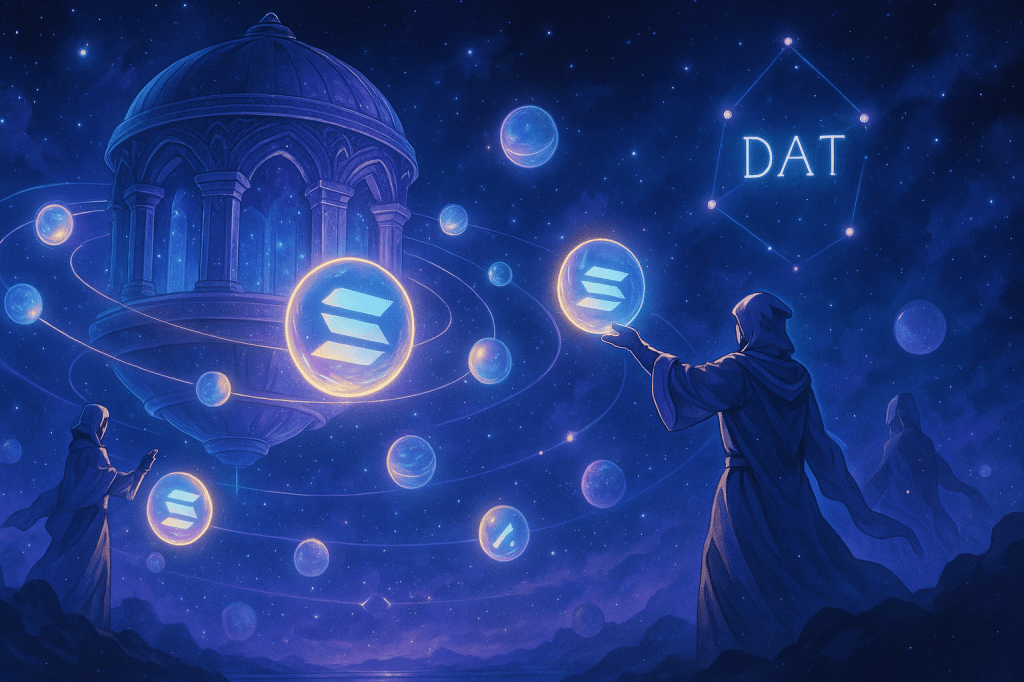
Solana-focused treasury firms are continuing to increase their token reserves, adding to a growing pool of institutional-style crypto holdings.
Upexi and BIT Mining Boost Allocations
On Thursday, Upexi (Nasdaq: UPXI) disclosed it had added nearly 18,000 SOL, bringing its total holdings to more than 2 million tokens. At current prices, Upexi’s treasury is valued at over $456 million.
Meanwhile, BIT Mining (NYSE: BTCM) nearly doubled its holdings, acquiring 17,221 SOL to reach a total of 44,000 tokens, worth about $9.9 million. The company also announced plans to rebrand as SOLAI Limited.
Both stocks traded higher on the day, with Upexi up over 5% to $5.76 (market cap: $291 million) and BTCM up more than 6% to $2.94 (market cap: $48 million).
Part of a Larger DAT Strategy
These moves are part of a broader trend of digital asset treasuries (DATs) — firms that accumulate crypto assets using proceeds from public or private stock or debt sales. By doing so, they offer investors leveraged exposure to digital asset performance.
Collectively, Solana treasury companies now hold at least 4.67 million SOL tokens, according to company filings.
Much like ETFs or mutual funds, DATs typically report net asset value (NAV) per share. Upexi reported a “fully loaded” NAV of 1.2x, having purchased its SOL at an average of $151 per token, or about $306 million in total costs. This leaves the firm with an unrealized gain of $142 million, factoring in price appreciation and discounts on locked tokens.
Staking and Yield Generation
Beyond price exposure, DATs that hold proof-of-stake tokens often lock assets to generate yield. Upexi says its SOL staking earns approximately $105,000 daily, and the firm has introduced an “adjusted SOL per share” metric that incorporates:
- Capital issuance
- Discounted locked token purchases
- Staking revenue
Upexi’s adjusted SOL per share currently stands at $4.37, up 126% from $1.93 since its $100 million private equity raise in April.
Advisors and Expansion
BitMEX co-founder Arthur Hayes recently joined Upexi as its first outside advisor. Shareholders also approved an increase in authorized shares, allowing for future equity issuances. To date, Upexi has completed three rounds.
BIT Mining did not provide details on staking yields but confirmed it continues to operate in-house validators. Chairman and COO Bo Yu said its purchases would “strengthen our position in the ecosystem and help secure the network.”
In addition, BIT Mining has partnered with Brale Inc. to issue DOLAI, an “AI-native” stablecoin denominated in US dollars, on Solana.
Novogratz: Crypto Entering “Season of Solana” as Treasury Strategies and Regulation Align

Galaxy Digital CEO Mike Novogratz said on Thursday that the crypto market is entering what he called the “season of Solana”, pointing to fresh capital inflows and shifting regulatory attitudes in the U.S.
$1.65B Solana Treasury Raise
Speaking on CNBC, Novogratz highlighted a $1.65 billion fundraise for Forward Industries (ticker FORD), backed by Galaxy Digital, Jump Crypto, and Multicoin Capital. The raise will fund the development of what is projected to be the world’s largest Solana-focused treasury strategy, part of a broader trend of digital asset treasury companies building positions in altcoins.
Regulatory Shifts at the SEC
Novogratz also emphasized recent remarks from SEC Chair Paul Atkins, who has stated that the agency aims to “modernize the securities rules and regulations to enable our markets to move onchain.”
- Atkins has said most crypto tokens should not be classified as securities.
- He has also pushed for entrepreneurs and investors to raise capital onchain “without endless legal uncertainty.”
Novogratz called this shift a “radical departure” from past enforcement-heavy policies and said it is “pushing things in the right direction” for institutional adoption.
Nasdaq’s Tokenization Push
Separately, Nasdaq filed a rule change with the SEC to allow tokenized versions of listed stocks and ETFs to trade alongside their traditional counterparts. If approved, the change could enable blockchain-based settlement as soon as Q3 2026.
Why Solana?
Novogratz singled out Solana as well-suited for financial markets, citing its:
- High throughput
- Low-cost transactions
- Reliability and scalability for financial use cases
He added that Solana and Ethereum represent healthy competition in reshaping global market infrastructure, with multiple blockchains expected to coexist and interconnect as applications mature.
 Powerbuilding Digital