
Fitness / Motivation / Technology & A.I / Crypto

Welcome to Edition 112 of the Powerbuilding Digital Newsletter—your weekly mix of strength, mindset, tech, and digital innovation. Whether you’re a returning reader or joining us for the first time, this space is designed to keep you sharp, motivated, and ahead of the curve.
Here’s how we break it down this week:
- Fitness Info & Ideas
Practical training guidance and performance insights to help you build strength that lasts—without the noise or gimmicks. - Motivation & Wellbeing
Simple but powerful tools for cultivating discipline, balance, and resilience in your everyday life. - Technology & AI Trends
From AI breakthroughs to emerging digital tools, we spotlight the innovations that are changing how we live and work right now. - Crypto & Digital Asset Trends
No price chatter—just new platforms, apps, and blockchain use cases that are showing us what the future of digital value looks like.
Edition 112 is all about steady progress. Keep stacking wins, stay locked in, and keep building smarter—body, mind, and future.
Fitness
Why Squats, Deadlifts, and Bench Press Will Always Be King
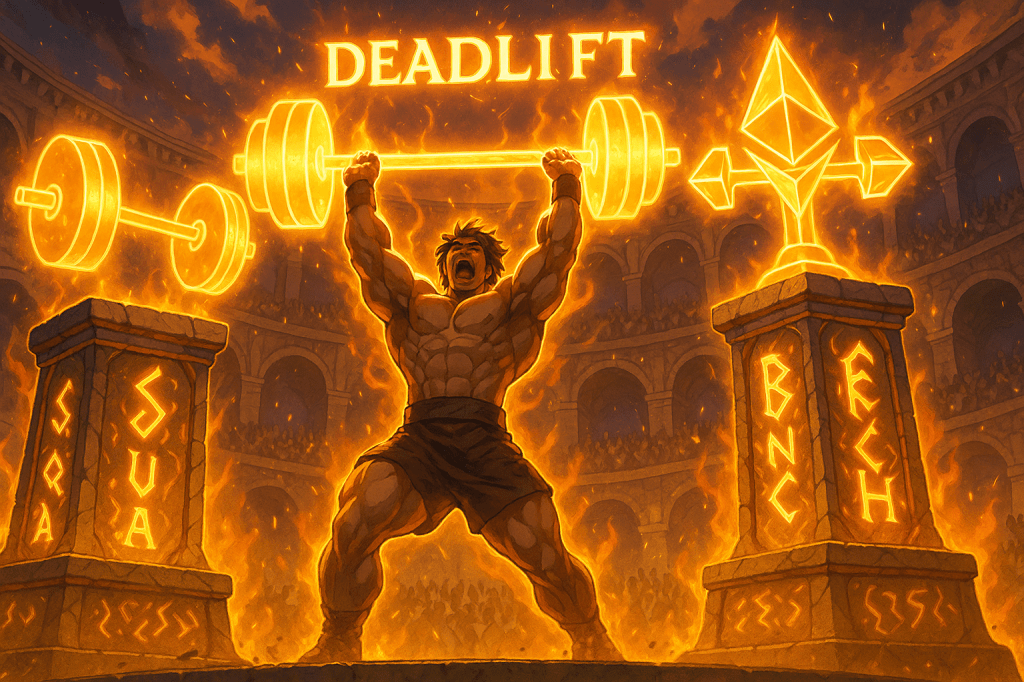
Trends in fitness come and go—machines, bands, fad workouts, even boutique class crazes. But the foundation of true strength remains unchanged: squats, deadlifts, and bench press.
Known as “the big three,” these lifts aren’t just exercises—they’re the ultimate test of raw power, discipline, and physical mastery. Whether you’re a beginner or an elite athlete, the big three will always reign supreme. Here’s why.
The Big Three Defined
- Squat: Lower-body powerhouse, testing leg strength, mobility, and core stability.
- Deadlift: Full-body pull that challenges grip, posterior chain, and raw power.
- Bench Press: Classic upper-body push, developing chest, shoulders, and triceps.
Why Compound Lifts Rule Over Isolation Exercises
Isolation exercises (like curls or leg extensions) build muscles in pieces. Compound lifts build systems. They recruit multiple joints and muscles, forcing the body to work as one unit. That’s real-world strength.
The Science of Multi-Joint Movements
Research in Journal of Strength and Conditioning Research shows that multi-joint lifts recruit more motor units, generate higher force output, and lead to greater hormonal responses (testosterone and growth hormone).
Benefits of Squats
- Builds quads, glutes, hamstrings, and core
- Enhances athletic power (jumping, sprinting)
- Improves balance and mobility
- Strengthens bones and joints under load
Benefits of Deadlifts
- Works the entire posterior chain: glutes, hamstrings, back
- Develops grip strength and core stability
- Teaches the hip hinge—a vital movement pattern
- Transfers directly to athletic and daily activities (lifting, carrying, explosive power)
Benefits of Bench Press
- Builds chest, shoulders, and triceps strength
- Improves pushing power for sports and daily function
- Reinforces shoulder stability
- Timeless benchmark of upper-body strength
Muscle Groups Activated by the Big Three
Together, squats, deadlifts, and bench press activate over 80% of skeletal muscle mass. No other trio of exercises delivers this kind of coverage.
Hormonal Responses and Strength Gains
Heavy compound lifts stimulate greater hormonal release—boosting testosterone, IGF-1, and growth hormone—which accelerates muscle growth. This is why lifters who focus on the big three typically gain more strength and size than machine-focused trainees.
Athletic Carryover Beyond the Gym
- Squats → sprint speed and vertical jump
- Deadlifts → acceleration, tackling, wrestling, lifting in real life
- Bench Press → pushing strength, upper-body dominance
Why These Lifts Build Mental Toughness
Squatting heavy demands courage. Deadlifting teaches grit. Benching tests discipline under pressure. These lifts build not only muscles but mental resilience, as they force lifters to confront heavy loads and overcome fear of failure.
Common Variations and When to Use Them
- Squat: front squat, safety bar squat, box squat
- Deadlift: sumo, Romanian, deficit, trap bar
- Bench: incline, close-grip, paused bench
Variations prevent plateaus while preserving the essence of the big three.
Programming the Big Three for Maximum Results
- Beginners: 3×5 or 5×5 programs (linear progression)
- Intermediates: 5/3/1 or DUP (daily undulating periodization)
- Advanced: Powerlifting cycles with peaking blocks
How Beginners Should Approach Squat, Deadlift, and Bench
- Focus on form first
- Start light, add weight gradually
- Train 2–3 times per week with adequate recovery
How Advanced Lifters Keep Progressing
- Rotate variations to target weak points
- Use tempo training, pause reps, or bands/chains
- Periodize training intensity and volume
Mistakes to Avoid With the Big Three
- Ego lifting (loading more weight than you can control)
- Ignoring mobility and warm-ups
- Skipping accessory work for balance
- Training too heavy, too often without deloads
Why Machines Will Never Replace Them
Machines can isolate muscles but they can’t replicate the stability, neural demand, or functional strength required by barbell lifts. Squats, deadlifts, and bench press demand total-body control—and that’s why they remain king.
The Timeless Crown of Strength
The fitness industry evolves, but the foundation of strength training never changes. Squats, deadlifts, and bench press are the crown jewels of lifting—building size, strength, athletic power, and resilience like nothing else.
No machine, gadget, or shortcut will ever replace the raw truth: if you want to be strong, if you want to build real muscle, the big three will always be king.
Sources
- Journal of Strength and Conditioning Research – Compound vs. Isolation Effects
- Schoenfeld, B. J. – Science and Development of Muscle Hypertrophy
- Zatsiorsky, V. M. – Science and Practice of Strength Training
- NSCA Guidelines on Barbell Training
Motivation
Inspired Action vs Forced Action: Which Fuels Your Motivation Best?

We’ve all been there: some days you feel lit up, energized, and unstoppable—like the work pours out of you effortlessly. Other days, just opening your laptop or lacing your shoes feels like dragging a boulder uphill.
This is the battle between inspired action and forced action. One flows from within. The other pushes from willpower. Both can move you forward—but one fuels you longer, and the other burns you out if abused.
Defining Inspired Action
Inspired action comes from alignment. It’s when your actions flow naturally from excitement, clarity, or a deep sense of purpose. It often feels light, energized, and even fun—yet highly productive.
Defining Forced Action
Forced action relies on pressure and discipline. It’s pushing yourself forward when motivation is absent. It often feels heavy, resistant, and effortful—but it can still get the job done.
The Psychology of Motivation: Intrinsic vs. Extrinsic Drivers
- Intrinsic motivation (internal drivers like growth, joy, curiosity) fuels inspired action.
- Extrinsic motivation (external rewards like money, status, deadlines) often drives forced action.
Research in Self-Determination Theory shows intrinsic motivation sustains performance longer. But extrinsic motivators can be powerful short-term catalysts.
Benefits of Inspired Action
- Work feels effortless (flow state)
- Higher creativity and problem-solving
- Sustainable energy and enthusiasm
- Stronger alignment with long-term goals
Downsides of Relying Only on Inspiration
- Inspiration is inconsistent—you won’t always feel it
- Waiting for “the mood” can delay progress
- Can lead to avoidance of necessary but unglamorous tasks
Benefits of Forced Action (Yes, It Has a Place)
- Builds grit and discipline
- Gets you through resistance and procrastination
- Ensures consistency when inspiration is absent
- Essential for building habits (early stages of training, learning, or business)
Downsides of Living on Force Alone
- Risk of burnout
- Lower creativity and joy
- Can create resentment toward your work or goals
- May trap you in autopilot rather than meaningful progress
Key Differences Between Inspired and Forced Action
| Aspect | Inspired Action | Forced Action |
|---|---|---|
| Energy Source | Excitement, purpose, alignment | Willpower, pressure, obligation |
| Emotional State | Light, creative, flowing | Heavy, resistant, effortful |
| Sustainability | Long-term, renewable | Short-term, draining if overused |
| Best For | Creativity, innovation, long-term goals | Consistency, habits, deadlines |
Neuroscience of Flow and Motivation
- Inspired action often correlates with dopamine release and flow states, where time feels suspended.
- Forced action leans on the prefrontal cortex and stress hormones—great for survival but exhausting when overused.
How to Spark Inspired Action When It’s Missing
- Reconnect with your “why”
- Change your environment (new space, music, light)
- Break tasks into smaller, exciting challenges
- Use visualization to see the outcome
How to Make Forced Action More Effective
- Stack habits onto existing routines
- Use accountability partners or deadlines
- Reward yourself for completing tough tasks
- Set strict time limits (“I’ll do 20 focused minutes”)
The Role of Discipline in Bridging Inspiration and Force
Discipline is the bridge. It allows you to show up consistently (forced action) while creating the conditions for inspiration to strike. The strongest people master both.
Everyday Examples: Work, Fitness, Relationships
- Work: Inspired = creative breakthroughs; Forced = meeting deadlines you’d rather skip
- Fitness: Inspired = a powerful workout you crave; Forced = showing up tired but finishing anyway
- Relationships: Inspired = planning a date with joy; Forced = keeping a commitment even when drained
Common Mistakes People Make With Motivation
- Believing they must “feel like it” to act
- Relying only on discipline with no passion behind it
- Confusing busyness (forced action) with aligned progress (inspired action)
Long-Term Success: Blending Inspiration With Consistency
The truth is: you need both. Inspired action fuels passion and creativity. Forced action builds resilience and consistency. Together, they form the engine of real success.
Conclusion: Which Fuels You Best?
Inspired action is the fire. Forced action is the furnace. If you wait only for inspiration, you stall. If you rely only on force, you burn out. The secret is mastering the balance—knowing when to push, and when to flow.
The people who never quit are the ones who act when inspired, and keep going when they’re not.
Sources
- Deci, E. & Ryan, R. – Self-Determination Theory
- Csikszentmihalyi, M. – Flow: The Psychology of Optimal Experience
- Duckworth, A. – Grit: The Power of Passion and Perseverance
- Journal of Applied Psychology – Motivation and Performance Studies
Technology & A.I
NVIDIA and OpenAI Announce $100 Billion Partnership to Build 10GW of AI Datacenters

NVIDIA and OpenAI have signed a letter of intent for a landmark partnership to deploy at least 10 gigawatts of AI datacenter capacity, powered by NVIDIA’s latest systems. The collaboration represents one of the largest infrastructure commitments in the history of artificial intelligence.
Under the agreement, NVIDIA will invest up to $100 billion in OpenAI as new datacenters come online. The rollout will begin in the second half of 2026, when the first gigawatt of compute is deployed using NVIDIA’s Vera Rubin platform.
Driving the Next Era of AI
The partnership is designed to provide the massive computing scale needed to train and run OpenAI’s next-generation models, with the goal of pushing toward superintelligence-level capabilities.
- 10 gigawatts of datacenters built and deployed with NVIDIA hardware.
- Millions of GPUs dedicated to OpenAI’s future model training and deployment.
- Up to $100 billion in staged investment from NVIDIA to support infrastructure buildout.
NVIDIA CEO Jensen Huang framed the deal as the natural next step in a decade-long collaboration:
“NVIDIA and OpenAI have pushed each other for a decade, from the first DGX supercomputer to the breakthrough of ChatGPT. This investment and infrastructure partnership mark the next leap forward—deploying 10 gigawatts to power the next era of intelligence.”
OpenAI CEO Sam Altman emphasized the central role of compute:
“Everything starts with compute. Compute infrastructure will be the basis for the economy of the future, and we will utilize what we’re building with NVIDIA to both create new AI breakthroughs and empower people and businesses with them at scale.”
Preferred Strategic Partner
As part of the agreement, OpenAI will work with NVIDIA as its preferred compute and networking partner for expanding its global “AI factory” operations. The companies will co-optimize roadmaps, aligning OpenAI’s model and infrastructure software with NVIDIA’s hardware and platform development.
OpenAI President Greg Brockman highlighted the long-term relationship:
“We’ve utilized NVIDIA’s platform to create AI systems that hundreds of millions of people use every day. We’re excited to deploy 10 gigawatts of compute with NVIDIA to push back the frontier of intelligence and scale the benefits of this technology to everyone.”
Global Collaboration
This partnership complements OpenAI’s existing work with Microsoft, Oracle, SoftBank, and the Stargate initiative, all aimed at building the most advanced AI infrastructure in the world.
OpenAI now serves over 700 million weekly active users, with widespread adoption among enterprises, small businesses, and developers worldwide.
Citi Upgrades Stylus Workspaces With Agentic AI Integration

Citi announced the launch of an upgraded version of its proprietary AI platform, Citi Stylus Workspaces, now enhanced with Agentic AI to handle more complex, multi-stage tasks.
The update allows employees to complete longer workflows with greater speed, efficiency, and insight. By connecting directly to Citi’s internal systems — including the global employee directory, project management tools, and enterprise platforms — the platform can also pull from web searches and external data analysis.
Citi’s Chief Technology Officer David Griffiths called the rollout a “pivotal moment” in empowering employees with smarter, faster, and more connected tools:
“We’re giving our people smarter, faster and more connected tools so they can focus less on manual tasks and more on the big ideas that drive our business forward.”
One-Prompt Workflows
The new capabilities streamline tasks that previously required multiple steps. For example, the platform can now:
- Identify the top five branded card businesses in the U.S.
- Distill their strategic goals
- Translate findings into Spanish
— all from a single prompt.
Rollout Plan
The upgrade will begin in September 2025 with thousands of employees gaining early access, followed by a staged expansion across the company. Citi is also launching dedicated training programs to ensure employees maximize the tool’s features.
CMS Rolls Out WISeR Model, Requiring AI-Powered Prior Authorization in Six States

The Centers for Medicare & Medicaid Services (CMS) will soon require physicians in six states to obtain AI-powered prior authorization for select Medicare services under its new pilot program, the Wasteful and Inappropriate Service Reduction (WISeR) model.
The program, which takes effect in January 2026 and runs through 2031, aims to reduce unnecessary care and lower costs. But lawmakers, provider groups, and policy experts are raising alarms that it could also restrict access and add new burdens to already strained medical practices.
What WISeR Does
- Applies to six states: Arizona, New Jersey, Ohio, Oklahoma, Texas, and Washington.
- Targets “low-value” services such as skin and tissue substitutes, electrical nerve stimulator implants, and knee arthroscopy for osteoarthritis.
- Excludes emergency and inpatient-only procedures to avoid delaying urgent care.
- Process: Providers must seek approval in advance or face post-service medical review. All denials will be reviewed by licensed clinicians.
CMS defines low-value care as services that provide little or no benefit, may cause harm, or generate unnecessary costs. In 2022, such procedures cost Medicare up to $5.8 billion, according to agency estimates.
Why It’s Controversial
Unlike most CMS pilot programs, WISeR participation is mandatory for providers in affected states. That has prompted backlash:
- Provider concerns: The Medical Group Management Association (MGMA) called the model “misguided,” warning it will increase administrative burden and risk delays in patient care.
- Lawmakers’ pushback: Forty-two Democratic members of Congress wrote to CMS Administrator Dr. Mehmet Oz, arguing that expanding AI-driven prior authorization “opens the door to further erosion of our Medicare system.”
- Transparency worries: Critics fear CMS will lack visibility into how AI tools make coverage decisions, raising oversight and accountability issues.
Potential Benefits
Some experts say WISeR could help reduce waste and fraud, particularly for accountable care organizations (ACOs) that bear responsibility for overspending. By blocking unnecessary services, ACOs may achieve greater cost savings, said Phoebe Ramsey, a former CMMI official.
Others point to precedent. Past pilots, like CMS’s non-emergency transport model, proved effective and were later expanded. Amy Bassano, former CMMI deputy director, noted WISeR could follow a similar path.
Balancing Cost and Care
Critics caution that scaling prior authorization too aggressively could repeat issues seen in Medicare Advantage, where denials have been linked to patients losing access to necessary care.
Still, supporters argue the model reflects CMS’s shift toward cost management after years of focusing on quality improvements. Liz Fowler, former CMMI director, said curbing low-value care is essential:
“CMMI should be able to walk and chew gum at the same time — reducing waste without compromising needed services.”
Looking Ahead
The WISeR model is set to run for five years, with CMS pledging to monitor results and make adjustments as needed. Stakeholders agree that the agency will face a “learning curve,” particularly with the use of AI-powered prior authorization systems.
As CMS tests new ways to control spending, WISeR may determine whether artificial intelligence becomes a permanent fixture in how traditional Medicare authorizes care.
Crypto
Vitalik Buterin Calls PeerDAS “Crucial” for Ethereum’s Growing Blob Storage Needs

Ethereum co-founder Vitalik Buterin has highlighted Peer Data Availability Sampling (PeerDAS) as a key solution for managing the network’s rising blob storage requirements. PeerDAS is slated for release as part of the upcoming Fusaka upgrade.
Why Blobs Matter
Ethereum currently produces six blobs per block, a milestone that has intensified concerns about data bloat. Blobs, introduced under EIP-4844, are temporary data containers designed to make Layer-2 rollups cheaper by storing data for about two weeks before expiring.
This design reduces permanent storage demands while still supporting transaction verification, enabling rollups such as Base, Worldcoin, Soneium, and Scroll to scale more efficiently. However, rapid adoption has pushed validator storage needs beyond 70 GB, with projections suggesting more than 1.2 TB if pruning is not applied.
How PeerDAS Works
PeerDAS addresses the issue by ensuring no single node stores the entire dataset. Instead:
- Each node verifies availability by downloading only a few chunks of data.
- If more than 50% of chunks are available, erasure coding can reconstruct the rest.
- Complete block data is only required in specific cases, such as during block broadcasts or recovery.
Buterin noted that the design assumes the presence of honest actors, but emphasized PeerDAS remains resilient even against large groups of dishonest nodes, as other peers can step in.
Phased Rollout Ahead
Despite years of research, Ethereum developers are cautious about rolling out PeerDAS. Instead, they plan to gradually raise blob capacity through Blob Parameter Only (BPO) forks:
- Dec. 17, 2025: Blob targets will increase from 6/9 to 10/15.
- Jan. 7, 2026: Limits will rise again to 14/21.
This staged approach allows the network to adjust safely while monitoring performance.
Big Picture
Buterin sees PeerDAS as essential for layer-2 expansion, higher gas limits, and Ethereum’s long-term vision of moving execution data fully into blobs. By balancing scalability and storage efficiency, PeerDAS could become a cornerstone of Ethereum’s future infrastructure.
Franklin Templeton Expands Benji Tokenization Platform to BNB Chain

Franklin Templeton is deepening its push into digital assets by expanding its proprietary Benji Technology Platform to the BNB Chain, the blockchain ecosystem associated with the world’s largest crypto exchange by trading volume.
Previously compatible with Ethereum, Solana, and Stellar, the move adds BNB Chain to the list of supported networks and reflects the firm’s broader mission to bring tokenized securities to both institutional and retail markets.
“Our goal is to meet more investors where they’re active, while continuing to push the boundaries of what tokenization can deliver with security and compliance at the forefront,” said Roger Bayson, head of digital assets at Franklin Templeton.
The Benji platform allows users to tokenize and trade mutual fund shares using blockchain rails, with the Franklin OnChain U.S. Government Money Fund (FOBXX) serving as the flagship product — the first U.S. mutual fund to use blockchain for transaction processing and share ownership recording.
This integration follows Franklin’s recent strategic alignment with Binance, aiming to bridge the gap between traditional finance (TradFi) and decentralized finance (DeFi).
“We see blockchain not as a threat to legacy systems, but as an opportunity to reimagine them,” said Sandy Kaul, EVP and Head of Innovation at Franklin Templeton.
The Benji platform leverages public blockchain networks to bring institutional-grade tokenization into mainstream financial services — a move that continues to blur the lines between old and new financial rails.
First U.S. Ethereum Staking ETF Launches Under 1940 Act Structure

REX Shares and Osprey Funds have launched the first Ethereum staking ETF in the U.S., trading under the ticker ESK. Structured under the Investment Company Act of 1940, the fund offers spot Ethereum exposure alongside monthly staking reward distributions—a combination that major asset managers have so far struggled to secure SEC approval for.
The launch follows the same regulatory approach used in REX-Osprey’s earlier Solana staking ETF (SSK) and the first Dogecoin ETF, both of which sidestepped the more traditional route taken by firms like BlackRock, Fidelity, and Franklin Templeton—whose staking proposals remain under SEC review.
“ESK is the first U.S. fund to provide cost-effective, convenient exposure to spot Ethereum via the 1940 Act ETF structure,” the firms said in a joint statement.
This move gives investors a new way to earn ETH staking rewards without directly managing tokens or validator infrastructure, further bridging traditional finance and decentralized networks.
REX and Osprey also have their sights on launching the first spot BNB ETF with staking, building a track record of innovating where larger institutions are still waiting on regulatory clarity.
Hashdex Expands Crypto ETF to Include XRP and Solana After SEC Ruling

Hashdex Asset Management and Nasdaq Global Indexes have expanded their Nasdaq Crypto Index US ETF (NCIQ) to include XRP, Solana, and Stellar, following recent U.S. SEC approval of generic listing standards for crypto exchange-traded products.
Originally launched with just Bitcoin and Ether, the NCIQ now reflects a broader range of digital assets as the regulatory landscape shifts. The ETF is designed to evolve over time, adding new cryptocurrencies that meet the index’s inclusion and listing criteria.
“Thanks to recent regulatory updates…NCIQ is expanding today and will adapt over time,” said Samir Kerbage, CIO at Hashdex.
The move comes on the heels of the SEC’s recent green light for Grayscale’s multi-asset crypto fund, which also includes XRP, Solana, Cardano, Ether, and Bitcoin.
Last week’s rule change—affecting how commodity-based trust shares are approved for listing—means that dozens of crypto ETFs are now cleared to move forward, significantly accelerating timelines for product launches across the industry.
With a more favorable regulatory tone and a shift in presidential administration, ETF providers are poised to launch a wave of diversified crypto investment vehicles aimed at both retail and institutional markets.
Gate Launches “Gate Layer” L2 Network Using OP Stack, Upgrades GT Tokenomics

Following the trend set by Coinbase’s Base and Kraken’s forthcoming network, crypto exchange Gate has unveiled Gate Layer—a new Layer 2 blockchain built on the OP Stack, Optimism’s modular rollup framework.
The network is designed to deliver a faster, low-cost Web3 experience while positioning Gate as more than just a centralized exchange. Gate Layer will serve as the cornerstone of the company’s “All in Web3” strategy, according to CEO Dr. Han Lin.
“The launch of Gate Layer completes our shift from a pure centralized exchange to a full on-chain Web3 ecosystem,” Lin said. “With GT and GateChain as the foundation, we’re aligning infrastructure, liquidity, and tokenomics under one roof.”
Key Features of Gate Layer:
- Built with OP Stack for Ethereum compatibility
- GateChain as settlement layer, integrating with Gate’s original chain launched in 2019
- GT staking mechanism built into the protocol
- Dual-deflationary GT model, with over 60% of supply burned through buybacks
- 5,700+ TPS and 1-second block times
- Cross-chain transfers enabled via LayerZero
GT Token Performance
The GT token currently trades around $15.93, with a market cap of $1.9 billion and a circulating supply of 119.4 million. It’s down about 3.4% on the day and remains below its all-time high of $25.94 earlier this year.
A Growing Trend Among Exchanges
Gate’s move echoes a broader trend where centralized exchanges adopt native chains to capture value, boost ecosystem growth, and expand into the L2 market. Coinbase’s Base demonstrated how proprietary L2s can generate revenue while becoming developer-friendly hubs for apps and tokens.
Gate aims to follow suit, using Gate Layer to launch a perpetuals trading hub and a no-code incubator for token launches—strategic moves to attract developers and onboard new users.
 Powerbuilding Digital