
Fitness / Motivation / Technology & A.I / Crypto

Welcome to Edition 117 of the Powerbuilding Digital Newsletter—your weekly source for strength, focus, and forward momentum. Whether you’re here to train smarter, think deeper, or stay tuned to the pulse of technology and innovation, this space is built for growth in every direction.
Here’s what’s inside this week:
- Fitness Info & Ideas
Practical, effective training strategies to help you build power, enhance endurance, and stay consistent—because real results come from rhythm, not rush. - Motivation & Wellbeing
The inner game always comes first. We’re exploring tools to sharpen your focus, protect your peace, and sustain motivation even when life feels heavy. - Technology & AI Trends
From AI breakthroughs to transformative digital tools, we’re unpacking the tech shaping the next era of productivity, creativity, and human potential. - Crypto & Digital Asset Trends
No market noise—just real innovation. Learn about emerging blockchain projects, Web3 platforms, and digital ecosystems creating utility and lasting impact.
Edition 117 is about momentum with purpose—progress that compounds, both physically and mentally. Stay locked in, stay learning, and let’s keep building the future together.
Fitness
The Best Accessory Workouts to Break Through Bench Plateaus

You’ve been there — the bar moves fast until it doesn’t. You’re stuck halfway up, wondering if you’ve peaked. But you haven’t hit your ceiling. You’ve hit your weak point.
Breaking a bench plateau isn’t about maxing out harder — it’s about training smarter. And the secret lies in the right accessory lifts that attack your weakest link head-on.
Why Bench Plateaus Happen
Most lifters stall because of:
- Weak triceps or chest drive
- Poor shoulder stability
- Lack of speed off the chest
- Weak scapular control
- Insufficient recovery or volume management
Each problem requires a targeted solution, not just more benching.
The Science of Sticking Points
Research from the Journal of Strength & Conditioning Research shows that strength plateaus often occur when prime movers outpace stabilizers or secondary muscles. That imbalance halts progress — no matter how strong your main lift feels.
Accessory work realigns those imbalances, improves bar path control, and restores force output.
Understanding Weak Links in the Bench
A great bench is built on:
- Chest: Explosive drive off the chest
- Triceps: Finishing lockout strength
- Shoulders & Upper Back: Stability and control
- Core & Legs: Total-body tension and transfer
Neglect one, and the chain breaks.
How Accessory Lifts Fix Limiting Factors
Accessory lifts isolate weaknesses that the bench press itself can’t fix. They strengthen stabilizers, improve muscle coordination, and increase time under tension for growth.
Think of them as performance amplifiers — they don’t replace your bench, they enhance it.
The Three Phases of a Bench Press
Every bench rep has three key segments:
- Off the chest – The bottom range; chest and lats dominate.
- Mid-range – Transition zone; shoulders and triceps engage.
- Lockout – Final phase; triceps and stability finish the lift.
Each phase can fail for a different reason — and each has its own fix.
Accessory Lifts for Each Phase
1. Off the Chest (Bottom Phase)
Goal: Improve power from the hole and tightness off the chest.
Top Accessory Lifts:
- Paused Bench Press – Teaches control and builds starting strength.
- Spoto Press – Strengthens the chest and mid-range without bouncing.
- Dumbbell Bench Press – Improves stability and range of motion.
- Chest Fly (Cable or Dumbbell) – Adds hypertrophy to pec fibers for drive.
2. Mid-Range Drive (Transition Zone)
Goal: Maintain bar speed through the hardest point.
Top Accessory Lifts:
- Incline Barbell Press – Emphasizes shoulders and upper chest for control.
- Floor Press – Removes leg drive, forcing pure upper-body strength.
- Board Press (2-Board) – Reinforces mid-range strength and stability.
- Overhead Press – Builds shoulder drive and transfer strength.
3. Lockout Strength (Top Phase)
Goal: Strengthen triceps and stabilizers to finish heavy lifts.
Top Accessory Lifts:
- Close-Grip Bench Press – Triceps overload with bench specificity.
- Pin Press – Builds static strength and tightness at lockout.
- JM Press – Bridges pressing and extension mechanics.
- Dips (Weighted) – Massive triceps and shoulder activation.
The Role of Triceps and Upper Back in a Strong Bench
Your bench press is only as strong as your triceps and back.
- Triceps: Power the lockout; train them 2–3 times weekly with compound and isolation work.
- Upper Back: Acts as a pressing platform. The tighter your back, the stronger your press.
Key Movements:
- Barbell Rows
- Face Pulls
- Rear Delt Flyes
- Seal Rows
- Pull-Ups
A stable base equals a stable bar.
Accessory Movements for Shoulder Stability
Strong shoulders stay healthy. Build durability with:
- Face Pulls – 3×15
- Cuban Rotations – 2×12
- Banded External Rotations – 2×20
- Scap Push-Ups – 2×15
Rotator cuff and scapular health are the foundation for long-term pressing.
Building Explosive Power With Speed Work
If the bar feels heavy at takeoff, add dynamic effort training:
- Speed Bench (50–60% 1RM) for 6–8 sets of 3 reps
- Use resistance bands or chains to develop acceleration through the sticking point.
Speed creates carryover to heavy work by improving neural efficiency.
Core and Leg Involvement — The Hidden Bench Boosters
The bench is a full-body lift when done right.
- Tight glutes anchor your base.
- Core tension keeps your spine stable.
- Leg drive transfers energy through the torso.
Add:
- Weighted Planks
- Hanging Leg Raises
- Glute Bridges
- Hip Thrusts
A strong midsection turns your bench into a total-body press.
How to Program Accessories Into Your Training
- After main bench work: 2–4 accessories max.
- Frequency: 2–3 bench-focused days per week (main lift + accessories).
- Focus: Train weaknesses, not favorites.
Example:
- Main Bench – 5×5
- Spoto Press – 3×6
- Barbell Row – 4×10
- Face Pulls – 3×15
Volume, Frequency, and Recovery Guidelines
- Strength Phase: 3–5 sets, 4–6 reps
- Hypertrophy Phase: 3–4 sets, 8–12 reps
- Recovery: Deload every 4–6 weeks; track fatigue through bar speed or RPE.
Muscle grows outside the gym—respect recovery like you respect volume.
Example 4-Week Bench Accessory Cycle
| Week | Focus | Main Accessory | Secondary | Isolation/Finisher |
|---|---|---|---|---|
| 1 | Off-Chest Power | Paused Bench | DB Press | Flyes |
| 2 | Mid-Range | Incline Press | Floor Press | Overhead Extensions |
| 3 | Lockout | Close-Grip | Pin Press | Dips |
| 4 | Speed & Recovery | Speed Bench | Pull-Ups | Face Pulls |
Repeat with progressive overload, then deload.
Common Bench Mistakes That Stall Progress
- Ignoring weak points and repeating the same volume scheme
- Skipping upper-back and rear-delt work
- Poor bar path (pressing forward instead of up-and-back)
- Lack of tension through legs and core
Small form errors compound into long-term stalls.
Nutrition and Recovery for Pressing Power
- Protein: 1g per lb of bodyweight daily
- Carbs: 2–3g per lb for glycogen recovery
- Creatine: 5g/day for consistent strength output
- Sleep: 7–9 hours — crucial for CNS recovery
Fuel the body if you expect it to perform.
Long-Term Bench Progress: Patience Meets Precision
Breaking through a plateau isn’t about ego-lifting or program hopping. It’s about strategic refinement—identifying weak links, attacking them with precision, and giving the body time to adapt.
The strongest lifters don’t chase numbers—they chase mastery.
Build the Foundation, Break the Ceiling
Every pound you add to your bench is earned through balance—technique, accessory work, recovery, and mindset.
Stop grinding into walls. Build smarter, lift cleaner, and reinforce every weak point until nothing can stop the bar from moving.
Because a true bench breakthrough doesn’t come from brute force—it comes from building the body to handle it.
Sources
- NSCA – Bench Press Biomechanics and Training Variables
- Schoenfeld, B.J. – Science and Development of Muscle Hypertrophy
- Journal of Strength & Conditioning Research – Weak Point and Accessory Training Studies
- McGill, S. – Ultimate Back Fitness and Performance
Motivation
The Power of Self-Reflection: How to Read Your Own Patterns

You can’t change what you won’t confront.
And you can’t confront what you never notice.
In a world obsessed with action, few people stop long enough to ask the questions that actually shape their lives: Why do I keep repeating this? Why do I sabotage progress? Why do I feel stuck in the same cycles?
That’s the purpose of self-reflection — not to judge yourself, but to see yourself clearly.
What Self-Reflection Really Means
Self-reflection isn’t just thinking about your day or replaying mistakes. It’s the skill of stepping outside your thoughts and observing patterns from a higher level.
It’s less about “Why did this happen?” and more about “What part of me keeps choosing this?”
Why Most People Avoid It
True reflection is uncomfortable. It forces you to see the gap between who you are and who you say you want to be.
That’s why most people choose distraction over depth — it’s easier to scroll, blame, or run than to face the mirror. But growth requires honesty, and honesty requires stillness.
The Psychology Behind Self-Reflection and Growth
Research in Cognitive Behavioral Psychology shows that awareness of thought patterns creates neural flexibility — the ability to change habits by consciously redirecting attention.
In simple terms: once you see the pattern, you can stop being controlled by it.
The Power of Pattern Recognition
Every decision, reaction, and relationship follows a pattern. Some build you, some break you.
Self-reflection helps you find the code beneath your life — the repeated loops that dictate your results.
If you’ve ever said, “Why does this keep happening to me?” — that’s your pattern calling you out.
How Unconscious Habits Shape Your Reality
The majority of your choices come from unconscious conditioning — past experiences, fears, and beliefs you never questioned.
Reflection brings those programs to light. It helps you shift from living reactively to living intentionally.
Step 1: Slow Down Enough to Notice
You can’t analyze what you rush through.
Create time each day to disconnect — from your phone, your tasks, your noise.
Stillness is uncomfortable at first because silence reveals truth. But the longer you practice it, the clearer your patterns become.
Step 2: Identify Recurring Emotional Themes
Emotions are data.
Ask yourself:
- What emotions show up most often?
- When do I feel drained, anxious, or alive?
- What triggers those states?
You’ll start to see cycles — similar feelings tied to similar situations. That’s where growth begins.
Step 3: Track Behavior and Decision Patterns
Look for repetition in your actions:
- Do you quit when progress slows?
- Do you chase intensity over consistency?
- Do you overcommit, then burn out?
Patterns aren’t random — they’re the visible signature of your inner programming.
Step 4: Ask Better Questions
Your growth depends on the quality of your questions.
- “What am I avoiding?”
- “What is this reaction trying to protect me from?”
- “What am I trying to control that I should release?”
- “What does this situation reveal about me, not them?”
The right questions don’t give comfort—they give clarity.
Step 5: Turn Reflection Into Action
Awareness without action changes nothing.
Once you recognize the pattern, choose differently—no matter how small the step.
If your old response was avoidance, try engagement.
If your old pattern was rushing, try patience.
The change starts when awareness meets discipline.
Journaling and Data: Turning Introspection Into Clarity
Your journal is a mirror for your evolution. Write what you feel, what triggered it, and what you learned.
Over time, you’ll see the data of your transformation — not opinions, but evidence.
The Role of Silence and Solitude in Self-Awareness
You can’t hear your inner voice in constant noise.
Schedule solitude the way you’d schedule training. Reflection sharpens intuition, decision-making, and emotional resilience — all the skills that separate the reactive from the wise.
Using Feedback Without Losing Authenticity
Reflection doesn’t mean isolation. The people around you can reflect patterns you can’t see.
Ask for feedback—but filter it. Learn from it, don’t live for it.
Reflection in Fitness, Business, and Relationships
- Fitness: Recognize training burnout patterns or self-sabotaging nutrition habits.
- Business: Spot cycles of overworking or chasing trends instead of strategy.
- Relationships: Notice emotional loops—like seeking validation or avoiding vulnerability.
In every area, reflection transforms chaos into clarity.
Common Traps of Overthinking vs. True Reflection
Overthinking analyzes to avoid action.
Reflection analyzes to create action.
Overthinking is emotional paralysis; reflection is emotional preparation.
Don’t confuse rumination with growth.
How to Build a Lifelong Reflection Practice
- Daily check-in: What went well? What drained me? What did I learn?
- Weekly review: Where did I repeat old patterns?
- Monthly recalibration: What needs to change for alignment?
- Quarterly solitude: Step away, reflect deeply, reset.
Consistency turns reflection from a tool into a superpower.
Awareness Is Power
Life doesn’t change just because you wish it would—it changes because you see it clearly and choose better every time it repeats.
Reflection isn’t soft. It’s strength turned inward.
It’s how you break cycles, build wisdom, and live with discipline and self-respect.
When you learn to read your own patterns, you stop living on autopilot—and start leading your life with purpose.
Sources
- Ryan & Deci – Self-Determination Theory
- Kahneman, D. – Thinking, Fast and Slow
- Journal of Cognitive Behavioral Therapy – Metacognitive Awareness Research
- Aristotle – Nicomachean Ethics (On Self-Knowledge)
Technology & A.I
Cathie Wood Bets Big on Humanoid Robots: “The Biggest Embodied AI Opportunity”
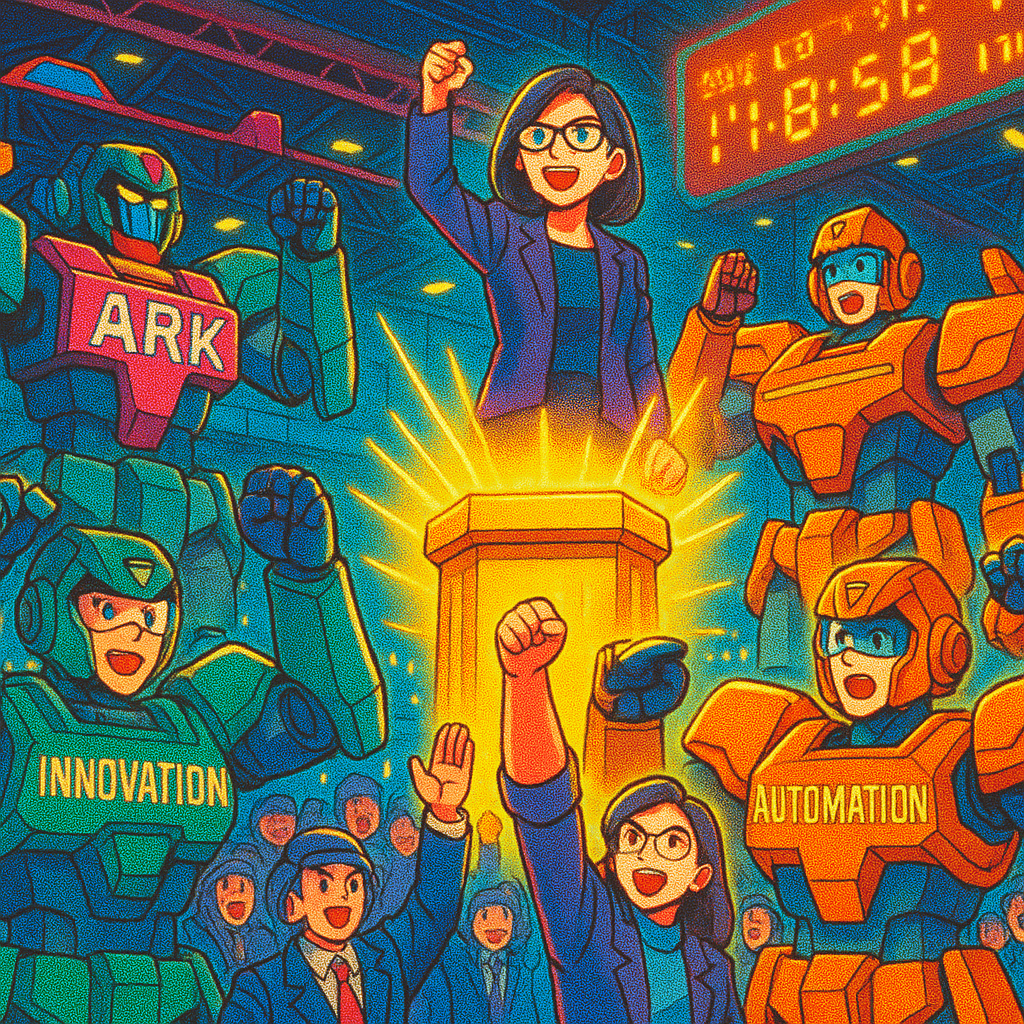
Cathie Wood, founder of ARK Invest, is doubling down on the next frontier of artificial intelligence: humanoid robots.
Speaking at the Future Investment Initiative in Riyadh this week, Wood shared her bold outlook that robots designed to move, look, and function like humans may become the most valuable use case of AI — outpacing current buzz around large language models, search enhancements, and productivity tools.
“I think the chaser is going to be humanoid robots,” Wood said in an interview with CNBC. “And I think that is going to be the biggest of all the embodied AI opportunities.”
Beyond the Hype: Why Embodied AI Could Reshape Everything
While some investors fear we’re entering another AI bubble, Wood disagrees. She argues that embodied AI — physical machines that interact with the real world — will transform transportation, healthcare, logistics, and daily consumer life.
From robotaxis to personal assistants that shop for you, she sees humanoid robots as a logical evolution of AI’s progress in software.
“If our expectations for AI — especially embodied AI — are correct,” she said, “we are at the very beginning of a technology revolution.”
Tesla’s Optimus: 80% of Future Value?
One of the boldest bets in this space is Tesla’s Optimus robot, which Elon Musk claims will eventually represent 80% of Tesla’s total value. That’s no small endorsement — and it aligns with ARK Invest’s conviction.
Wood’s ARKQ ETF, focused on AI and robotics, currently holds:
- Tesla: 9.16%
- Palantir: 7.02%
- AMD: 6.14%
Each is positioned at the intersection of automation, machine learning, and next-gen hardware infrastructure.
Caution: Short-Term Volatility Still Possible
Despite her long-term optimism, Wood also warned of a possible “reality check” for tech stocks if interest rates shift downward, potentially rattling high-growth sectors in the short term.
But she remains firm: “I do not believe AI is in a bubble.”
Enterprise AI Will Take Time — But Consumers Are Ready Now
Wood emphasized that enterprise adoption of AI will take longer due to restructuring needs and integration complexity — a space where firms like Palantir are likely to thrive.
But on the consumer side, adoption is moving fast.
“We’re all looking forward to our personal assistants doing our shopping for us,” Wood said. “And I’m excited about how much my productivity as an individual is going to increase with AI. It already has in terms of research.”
This signals a key shift: AI is no longer just a backend tool — it’s becoming a real-world agent.
Whether it’s humanoid robots, self-driving fleets, or AI healthcare workers, we’re entering an age where AI takes physical form — and Cathie Wood wants to be first at the table.
Eli Lilly and NVIDIA Team Up to Build AI Supercomputer for Drug Discovery

Two giants — Eli Lilly and NVIDIA — are joining forces to build what they’re calling the pharmaceutical industry’s most powerful AI supercomputer, aiming to revolutionize how medicines are discovered, developed, and delivered.
The Mission: Accelerate Medicine, Cut Costs
Drug development is notoriously slow and expensive, often taking 10+ years from initial testing to commercial availability. This partnership aims to compress that timeline — using AI at industrial scale to accelerate breakthroughs and reduce costs across the pipeline.
The new AI supercomputer, slated to go live in January 2026, will be owned and operated by Eli Lilly, running on more than 1,000 NVIDIA Blackwell Ultra GPUs connected through a high-speed network. Together, this setup forms a state-of-the-art “AI Factory” — a platform that will train, refine, and deploy AI models at scale to tackle key challenges in biopharma.
A Scientific Microscope at Supercomputer Scale
“This is like building an enormous microscope for biologists,” said Thomas Fuchs, Chief AI Officer at Lilly. The system will allow researchers to simulate and test millions of experiments simultaneously, accelerating the discovery of novel molecules that might never be found through human analysis alone.
It’s a fundamental shift — not just in computing power, but in scientific approach. Instead of brute-force trial and error, AI will learn and adapt from patterns across datasets worth over $1 billion, built from Lilly’s decades of research.
“We’re hopeful we’ll discover molecules we never would have with humans alone,” said Diogo Rau, Lilly’s Chief Information and Digital Officer.
From Proprietary AI to Sector-Wide Collaboration
The AI supercomputer will also integrate with Lilly TuneLab, a cloud-based AI and ML platform Lilly launched in September to give startups access to its proprietary discovery tools. TuneLab operates using federated learning, which means companies can use Lilly’s models without directly sharing data.
In exchange, participating biotech firms contribute their own research back into the system — creating a collaborative, cross-trained AI ecosystem that evolves with every partnership.
“Without AI infrastructure, we’ll never reach true precision medicine,” said Kimberly Powell, NVIDIA’s VP of Healthcare.
Beyond Discovery: Imaging, Biomarkers, and Personalized Care
This AI system won’t just be limited to molecule discovery.
It will also power next-gen medical imaging, enabling researchers to map disease progression in unprecedented detail. New biomarker development could enable faster diagnostics and real-time monitoring, unlocking the next wave of precision medicine — where treatment is tailored to a person’s genes, lifestyle, and environment.
There are no AI-designed drugs on the market — yet. But the number of AI-originated candidates entering clinical trials is rising, and partnerships like this are pushing biotech toward a new paradigm: compute-first medicine.
By the end of the decade, Eli Lilly expects this infrastructure to start producing measurable business results — and, more importantly, life-saving treatments.
This is the real-world AI transformation most people aren’t talking about yet. While LLMs and image generators grab headlines, AI in life sciences is laying the foundation for a future where cures are discovered faster, customized to the individual, and scaled for global impact.
The U.S. Is Building the World’s Most Ambitious AI Supercomputer—And It’s Not Just About Tech Bragging Rights

The U.S. Department of Energy just lit the fuse on what may be the most powerful scientific tool ever created.
In partnership with NVIDIA and Oracle, the DOE is building Solstice—a next-generation AI supercomputer loaded with a staggering 100,000 NVIDIA Blackwell GPUs, making it the most formidable system of its kind. Its smaller sibling, Equinox, will deploy an additional 10,000 GPUs and is slated to go online in early 2026.
Together, these systems will deliver 2,200 exaflops of AI performance—an unprecedented leap in computing capacity aimed at nothing less than rewriting the playbook for American science, defense, and energy leadership.
And they’re not being built in secretive Silicon Valley bunkers—they’re landing in Argonne National Laboratory, the DOE’s crown jewel for scientific discovery.
More Than Just a Supercomputer—This Is an AI Discovery Engine
Solstice and Equinox aren’t just faster—they’re smarter.
These systems will help train frontier models and reasoning agents that can assist in everything from discovering new cures to designing next-gen energy systems. Using tools like NVIDIA Megatron-Core and TensorRT inference software, researchers will be able to run complex AI workflows that previously took months—in hours.
This is the age of agentic AI—models that don’t just process data but actively participate in scientific discovery. Think of them as research collaborators that never sleep.
A New Model for U.S. Innovation: Public-Private Science at Scale
This initiative signals a serious pivot in how the U.S. mobilizes innovation. Solstice is being built through a public-private partnership model, combining the DOE’s mission with industry capital and commercial use cases.
That means AI built for public good, accelerated by enterprise resources—without sacrificing sovereignty or national interest.
“We’re building America’s engine for discovery,” said NVIDIA CEO Jensen Huang. “This is the most advanced AI infrastructure ever created.”
A Shift in National Strategy—and a Global Signal
DOE Secretary Chris Wright called this partnership a “common sense” evolution in America’s tech strategy, saying, “Thanks to President Trump, we’re turning shared innovation into national strength.”
In an age where global influence depends on scientific speed, the U.S. isn’t just catching up—it’s changing the game.
By connecting these systems with other DOE assets like the Advanced Photon Source, researchers will be able to combine real-time experimentation with AI-powered analysis—cutting discovery time from years to weeks.
AI as Infrastructure—Not Just Industry
This collaboration repositions AI not just as a product, but as critical infrastructure—the scientific equivalent of highways and power grids.
NVIDIA’s Vision for America’s Next Industrial Revolution: Factories That Think, Robots That Evolve

A new industrial age is taking shape—and NVIDIA is at the heart of it.
Today, the chip and AI powerhouse announced that America’s top manufacturers, robotics firms, and software innovators are harnessing NVIDIA Omniverse™ to design the next generation of AI-driven factories and autonomous robots. The goal? To reignite U.S. manufacturing, close labor gaps, and build resilient, intelligent industrial systems for the future.
“AI is transforming the world’s factories into intelligent thinking machines,” said NVIDIA CEO Jensen Huang. “Together with America’s manufacturing leaders, we’re building physical AI, Omniverse digital twins, and collaborative robots that will drive productivity, resilience, and competitiveness.”
Digital Twins, Real Results
At the center of this push is NVIDIA’s Mega Omniverse Blueprint—an “operating system” for the Industrial AI era. It’s expanding to simulate not just fleets of robots, but entire digital twin factories.
Industry giant Siemens is the first to integrate its industrial software into the platform, enabling live 3D digital twins of massive factories. This new stack—part of Siemens Xcelerator—lets engineers design smarter, faster, and with live data flowing into their digital models in real time.
Leading robot manufacturers like FANUC and Foxconn Fii are jumping in too, building OpenUSD-based 3D twins of their hardware. That means equipment can be virtually “dragged and dropped” into factory simulations—reducing setup time and costly trial-and-error in the real world.
Foxconn is already applying this in Houston, where it’s building a 240,000-square-foot facility to manufacture NVIDIA’s AI infrastructure.
$1.2 Trillion in U.S. Factory Investment Is Just the Beginning
Over $1.2 trillion in U.S. factory investments are expected this year alone—from semiconductors to pharma to electronics. And leading companies are leaning into NVIDIA’s industrial AI stack to get ahead.
- Belden is using Omniverse + Accenture’s Physical AI Orchestrator to create virtual safety fences and quality inspections in real-time.
- Caterpillar is simulating its supply chain and production lines to boost uptime and automate predictive maintenance.
- Lucid Motors is building real-time factory planning tools to optimize layouts and train AI-driven robotics.
- Toyota is designing full-facility simulations in Kentucky using iw.sim tech built from NVIDIA’s industrial blueprint.
- TSMC and Wistron are deploying NVIDIA Isaac™ robotics to boost productivity in fabs and assembly plants across the U.S.
The Rise of the Robotic Workforce
This isn’t just about machines. It’s about redefining the American workforce with smart, adaptable robots built on NVIDIA’s three-tier architecture—vision, simulation, and action.
- Figure AI is racing to build large-scale humanoid robots trained on Helix models and NVIDIA’s Isaac platform.
- Agility Robotics powers its Digit humanoid with Jetson AGX Thor™ for real-time control in dynamic environments.
- Amazon Robotics compressed years of R&D into 12 months with NVIDIA Omniverse, launching the BlueJay multi-arm system for automated warehousing.
- Skild AI and FieldAI are training cross-body robot brains for locomotion, manipulation, inspection, and more using Isaac Sim and Cosmos-generated datasets.
AI-Powered Infrastructure—At the Edge and in the Cloud
The infrastructure behind this revolution is just as powerful.
- NVIDIA IGX Thor™, powered by Blackwell GPUs, is being adopted by firms like Diligent Robotics, EndoQuest, Joby Aviation, and others to drive edge AI in hospitals, trains, and aerospace.
- Google Cloud and Microsoft Azure are rolling out RTX Pro 6000 Blackwell GPU instances, enabling enterprises to simulate, optimize, and deploy industrial AI workloads faster than ever.
This is more than robotics. It’s a full-stack transformation of how America builds—factories that simulate themselves before breaking ground, machines that learn like humans, and supply chains that anticipate disruption before it happens.
NVIDIA isn’t just selling chips anymore. It’s laying the tracks for AI-powered industrial self-reliance, reshaping the physical economy from the inside out.
Welcome to the next chapter of American manufacturing. It thinks, learns, adapts—and it’s being built right now.
Palantir and NVIDIA Partner to Launch a Unified AI Stack for Enterprise & Government Systems

Two of the most advanced players in artificial intelligence—Palantir Technologies and NVIDIA—have announced a strategic collaboration to build a fully integrated technology stack designed specifically for operational AI at scale.
The initiative combines Palantir’s Ontology-based AI Platform (AIP) with NVIDIA’s accelerated computing, optimization libraries, and open AI models. Together, they aim to provide a complete solution for enterprises and public sector organizations looking to operationalize artificial intelligence across logistics, finance, retail, healthcare, defense, and more.
“We’re creating a next-generation engine to fuel AI-specialized applications and agents that run the world’s most complex industrial and operational pipelines,” said NVIDIA CEO Jensen Huang.
An Integrated AI Operating System
At the core of this offering is Palantir’s Ontology, which acts as a digital mirror of an organization’s operations—structuring workflows, logic, and real-world objects into dynamic, interpretable systems.
When paired with NVIDIA’s CUDA-X libraries, NeMo Retriever, Nemotron™ reasoning models, and cuOpt™ for route and decision optimization, this stack enables:
- Real-time automation of complex workflows
- Domain-specific AI agents
- Context-aware reasoning and decision intelligence
- Custom AI pipelines for highly regulated industries
Alex Karp, CEO of Palantir, emphasized the urgency of real-world AI value:
“We are focused on deploying AI that delivers immediate, asymmetric value to our customers… This partnership fuses decision intelligence systems with the most advanced AI infrastructure in the world.”
Lowe’s Adopts the Stack to Reinvent Supply Chain Optimization
Lowe’s is one of the first adopters of this new operational AI framework. The company is using the joint NVIDIA-Palantir stack to build a live digital twin of its global supply chain, enabling continuous AI-driven optimization.
“Even small shifts in demand can ripple through global logistics,” said Seemantini Godbole, EVP and Chief Digital & Information Officer at Lowe’s. “We’re reimagining our retail logistics using real-time intelligence to boost agility and customer outcomes.”
Security, Compliance, and Scalable Intelligence
Palantir’s AI Platform already supports high-compliance workloads in defense, energy, and healthcare. This partnership enhances the platform’s capabilities through:
- Native integration of NVIDIA accelerated computing
- Support for reasoning agents trained on enterprise data
- Fine-tuning and inference pipelines aligned with secure data architectures
The collaboration will also bring NVIDIA Blackwell architecture to AIP—accelerating AI workflows from data preprocessing to full-scale deployment.
Combined with NVIDIA’s AI factories and Palantir’s domain modeling, the system offers an end-to-end AI infrastructure for mission-critical decisions in environments where precision, speed, and security are non-negotiable.
The Palantir-NVIDIA partnership signals a paradigm shift in AI deployment—from siloed models and dashboards to operational intelligence systems that run the core of an enterprise or government agency.
This isn’t just AI for insights. It’s AI for action.
For organizations looking to digitize complex operations, enhance resilience, and deploy AI with confidence, this new stack could serve as the foundation for long-term transformation.
Crypto
MetaMask’s Multichain Gambit: From Wallet to Gateway

MetaMask, once synonymous with Ethereum, is transforming into a full-stack crypto access layer. With 30 million monthly active users (MAUs), its pivot toward native Solana support and eventual Bitcoin integration signals more than a feature update — it’s a calculated move to reclaim relevance in an increasingly multichain world.
The strategic logic is clear: Ethereum is no longer the only place where users engage. As of June, Solana’s active addresses rivaled every other layer-1 and layer-2 network combined (Artemis data), and Bitcoin’s ecosystem is evolving rapidly beyond static value storage, driven by ordinals, inscriptions, and Lightning applications.
One Wallet, Three Chains
In late May, MetaMask introduced native support for SOL and SPL tokens, removing the need for Phantom or Solflare extensions. Ethereum and Solana now live side-by-side inside the same UI. When Bitcoin support lands — expected in 2025 — MetaMask becomes the first major wallet to offer native coverage for all three ecosystems under a single seed phrase.
From a UX standpoint, this is a significant simplification. Users will manage Ethereum, Solana, and Bitcoin assets through one interface, one recovery method, and unified swap and bridge functionality.
But this consolidation isn’t without risk. A single compromised seed phrase now puts all chains at risk — including EVM (secp256k1), Solana (ed25519), and Bitcoin’s derivation methods. Consensys has published best practices, but blast radius vs convenience will remain a critical debate for users and developers alike.
Account Abstraction: The Invisible Layer
To address these UX-security trade-offs, MetaMask is tying its multichain roadmap to account abstraction (AA). With the Delegation Toolkit and upcoming EIP-7702, MetaMask is positioning itself for a future where:
- Users don’t see seed phrases
- Transactions are gas-sponsored and batched
- Dapps interact via session-style permissions
The vision: invisible wallets. The frictionless, app-like experience that mainstream users expect — but with self-custody beneath the surface.
This mirrors moves by Coinbase Smart Wallet, which now boasts 1M+ accounts on Base via passwordless onboarding. The difference? MetaMask aims to achieve this cross-chain, not just within a single rollup or L2.
Distribution as a Competitive Edge
Wallet UX now dictates ecosystem exposure. If MetaMask promotes Solana dApps or Bitcoin inscriptions through its default view, millions of EVM-native users may sample new chains simply because the interface makes it easy.
This distribution effect is powerful:
- Phantom already supports Ethereum and Bitcoin, but with 15M MAUs — half of MetaMask’s reach.
- If MetaMask converts just 15% of users into active cross-chain participants, that’s over 4.5 million new potential Solana or Bitcoin users overnight.
The fight is no longer over key formats or dev tooling. It’s over defaults — the first screen users see, the first swap they try, and the first connection they make.
The Phantom Response & Strategic Divergence
Phantom, the Solana-native wallet, is unlikely to cede mindshare quietly. Expect them to double down on features like:
- Native NFT support
- Token launch discovery
- Social and creator-focused experiences
MetaMask, by contrast, is pursuing breadth: abstracted, chain-agnostic workflows powered by consistent interfaces and gasless transactions.
Both paths are valid. But only one can become the default entry point for the next 50 million users.
Regulatory Friction in the Background
All of this plays out under a regulatory shadow. The SEC’s 2024 lawsuit against Consensys over MetaMask’s swap and staking products adds uncertainty. Each new feature, chain, or revenue stream must now pass through a legal filter.
Meanwhile, OKX Wallet operates more freely as a full super-app — 100+ chains, smart account support, and a lighter regulatory footprint. MetaMask doesn’t have that flexibility. It must straddle a difficult middle ground:
- Too decentralized to pivot into custody
- Too large to avoid regulatory attention
- Too influential to ignore cross-chain demand
2026: Three Tabs, One Wallet
If MetaMask lands Bitcoin integration by year-end, 2026 opens with a wallet that treats Ethereum, Solana, and Bitcoin not as separate ecosystems — but as tabs in the same digital browser.
That’s a paradigm shift.
The wallet no longer just holds keys — it shapes behavior. The chain that loads by default becomes the chain users build on. The swap path that’s shortest becomes the one they return to.
The winner of the wallet wars won’t be the one with the most chains — but the one with the cleanest path to action.
MetaMask isn’t just chasing multichain parity. It’s trying to redefine what a wallet is.
Bitwise Launches First-Ever Solana Staking ETF (BSOL) on NYSE

Bitwise Asset Management has officially rolled out the Bitwise Solana Staking ETF (ticker: BSOL) on the New York Stock Exchange, providing institutional and retail investors with direct, fully staked exposure to Solana (SOL) — a first-of-its-kind product for the U.S. market.
With this launch, Bitwise is positioning BSOL as a yield-generating, regulated investment vehicle that tracks the performance of SOL while capturing the network’s native staking rewards — a compelling proposition in a yield-starved, risk-recalibrated macro environment.
Key Features of BSOL:
- Direct 1:1 SOL Exposure: Investors gain full economic participation in SOL price movement without direct token custody.
- 0.20% Management Fee: Waived to 0% for the first three months on the first $1B in assets, encouraging early institutional inflows.
- Staking Yield Participation: The fund will stake 100% of its SOL holdings, aiming to capture Solana’s average 7% annualized rewards (subject to change).
- Staking Infrastructure by Helius: Helius, a proven validator with over 13 million SOL staked, will handle all protocol-level operations, ensuring security and performance.
Strategic Context
This ETF builds on Bitwise’s growing product suite — now comprising over 30 crypto-focused investment vehicles — and cements its position as a leading bridge between traditional finance and decentralized assets. With over $15 billion in assets under management, Bitwise serves a growing roster of RIA firms, family offices, private wealth platforms, and 15+ banks and broker-dealers.
Why This Matters
For institutions and advisors seeking diversified crypto exposure, BSOL offers three advantages:
- Regulatory Comfort: The ETF structure reduces operational complexity, providing an SEC-regulated wrapper around an otherwise volatile asset class.
- Yield Enhancement: Unlike many passive crypto ETFs, BSOL earns on-chain yield through native staking — a potentially meaningful source of alpha.
- Access to Solana’s Growth: Solana has emerged as one of the most active blockchain ecosystems in terms of users, transactions, and developer adoption, making it a strategic addition to any forward-looking digital asset allocation.
Broader Implications
As the ETFization of crypto accelerates, BSOL joins a growing wave of token-specific vehicles that offer simplified access and real economic participation — not just synthetic price exposure.
For wealth managers and allocators, BSOL may serve as a gateway to yield-generating crypto infrastructure while maintaining institutional-grade custody, liquidity, and compliance standards.
With the Solana ecosystem rapidly expanding — particularly in DeFi, NFTs, and consumer applications — BSOL represents a significant moment in mainstreaming access to on-chain economics.
Standard Chartered Forecasts $2 Trillion RWA Market by 2028 as DeFi Infrastructure Matures

In a bold projection that underscores the accelerating convergence of traditional finance and blockchain, Standard Chartered now expects tokenized real-world assets (RWAs) to reach $2 trillion in cumulative market value by 2028—a 57x increase from today’s $35 billion baseline.
The London-based investment bank published its latest digital asset outlook Thursday, positioning decentralized finance (DeFi) as a credible disruptor to legacy capital markets infrastructure.
“Stablecoin liquidity and DeFi banking are important pre-requisites for a rapid expansion of tokenized RWAs,” said Geoff Kendrick, Standard Chartered’s global head of digital asset research. “We believe a self-sustaining cycle of DeFi growth has started.”
DeFi Rails as a Foundation for Tokenized Capital Markets
Standard Chartered’s thesis rests on two critical developments:
- A scalable and trustless financial layer in DeFi capable of absorbing meaningful flows from traditional capital markets.
- Stablecoins serving as the liquidity engine that powers everything from tokenized Treasury markets to synthetic equities and beyond.
The bank breaks down its $2 trillion forecast across several asset classes:
| Tokenized RWA Segment | Estimated Allocation by 2028 |
|---|---|
| Tokenized Money-Market Funds | $750 billion |
| Tokenized U.S. Equities | $750 billion |
| Tokenized U.S. Funds | $250 billion |
| Private Equity, Commodities, REITs | $250 billion |
This shift, they argue, will be driven less by speculation and more by efficiency, liquidity, and programmable settlement mechanisms that legacy rails can’t match.
Stablecoins: The Liquidity Backbone
Standard Chartered points to the record-setting rise in stablecoin supply—now over $300 billion as of October 3, up nearly 47% year-to-date—as a key signal.
This liquidity base is not only enabling faster settlement and more dynamic capital flows, but also incentivizing new DeFi primitives, forming a feedback loop of innovation and adoption.
“In DeFi, liquidity begets new products, and new products beget new liquidity,” Kendrick noted. “This flywheel dynamic is already underway.”
Regulatory Hurdles Remain the Key Risk
Despite the growth trajectory, the report does flag regulatory uncertainty as a potential bottleneck. Particularly, the lack of comprehensive U.S. crypto legislation is seen as a systemic risk to investor confidence and institutional participation.
The report specifically warns that failure by the Trump administration to deliver meaningful digital asset regulation before the 2026 midterms could delay or stall progress.
The Bigger Picture
If realized, a $2 trillion RWA market would mark one of the largest capital migrations in modern financial history. It would also solidify DeFi’s role not as a fringe experiment, but as a foundational component of 21st-century market infrastructure.
Circle’s Arc Testnet Goes Live — Aiming to Become the Internet’s Economic Backbone

Circle isn’t just issuing stablecoins anymore — it’s building the rails they’ll run on.
This week, Circle officially launched the public testnet for Arc, a new layer-1 blockchain network purpose-built to act as an economic operating system for the internet. Over 100 major players across tech, finance, and payments are already building on it.
What is Arc?
Think of Arc as Circle’s sovereign layer-1, optimized for:
- ⚙️ Predictable, dollar-based transaction fees
- ⚡ Sub-second finality for payments and settlement
- 🕶️ Configurable privacy to meet both compliance and user demands
- 🌐 Global reach with local onramps baked into the core ethos
In Circle CEO Jeremy Allaire’s words, Arc is designed to “connect every local market to the global economy” — a protocol-native solution to the fragmented infrastructure behind capital markets, payments, FX, and lending.
Who’s Already In the Arena?
This isn’t your average testnet. The Arc rollout already features a who’s who of financial firepower:
- 💸 Payments: Visa, Mastercard
- 🏦 Traditional finance: Goldman Sachs, BNY Mellon, BlackRock, Apollo
- 🌍 Global stablecoin issuers: from Australia, Brazil, and Japan
- 🔧 Infra stack: Alchemy, Chainlink, Anthropic
- 🪙 Liquidity partners: Coinbase, Uniswap
With billions of users and trillions in flows touching this ecosystem, Circle is signaling that Arc isn’t a testbed — it’s a global settlement layer in the making.
Why It Matters
Circle has long been the backbone of crypto-native dollars. With USDC and EURC already integrated across dozens of chains, launching their own layer-1 gives Circle full-stack control — from issuance and movement to fees, privacy, and compliance logic.
This positions Arc to:
- Serve as a compliant global settlement layer for TradFi and DeFi
- Provide predictable, dollar-denominated gas — key for onboarding Web2 firms
- Enable DePIN, tokenized RWA platforms, lending, and remittance protocols to build with regulatory alignment in mind from day one
This is not another Ethereum competitor — Arc is carving out a regulatory-grade economic layer, with rails tailored for serious capital flows and enterprise-grade usage.
Early Signals of a Power Move
Allaire framed the Arc testnet as a moment of convergence: big finance, real-world assets, consumer payments, and programmable money finally operating under one modular roof.
If Circle pulls this off — blending compliance-first infrastructure with DeFi-level composability — it won’t just be building a new chain…
It’ll be building the default ledger for on-chain dollars and borderless finance.
 Powerbuilding Digital