
Fitness / Motivation / Technology & A.I / Crypto

Welcome to Edition 122 of the Powerbuilding Digital Newsletter—your weekly source for strength, clarity, and innovation. Whether you’re returning or joining us for the first time, this space is about one thing: consistent evolution—physically, mentally, and digitally.
Here’s what we’ve lined up for you this week:
- Fitness Info & Ideas
Straightforward, effective training insights to help you build power, endurance, and balance while keeping longevity front and center. - Motivation & Wellbeing
Power comes from alignment. We explore mindset techniques, daily systems, and mental resets to help you stay focused, calm, and productive. - Technology & AI Trends
The tech landscape is moving fast. We highlight the most relevant AI advancements, new tools, and digital trends shaping the modern world. - Crypto & Digital Asset Trends
Beyond price charts—we spotlight blockchain innovations, new apps, and use cases pushing Web3 closer to real-world impact.
Edition 122 is about grounded growth—moving forward with strength, awareness, and intention. Let’s get into it and keep building the next version of you.
Fitness
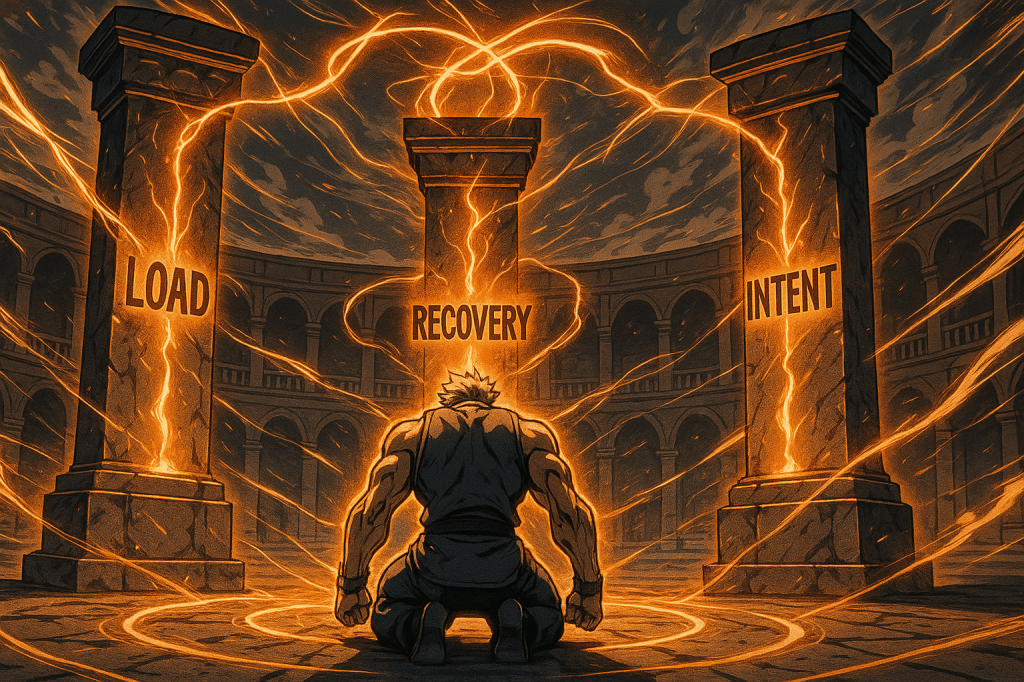
The 3 Keys to Training Longevity: Load Management, Recovery, and Intent
Anyone can train hard for six months.
Few can train smart for twenty years.
Longevity in lifting isn’t built on ego, shortcuts, or reckless intensity. It’s built on discipline, awareness, and consistency — the ability to apply stress, recover from it, and repeat the process with precision.
If you want to be strong for life, you must master three keys:
Load management, recovery, and intent.
What Training Longevity Really Means
Longevity isn’t just about avoiding injury — it’s about staying strong, functional, and motivated long after most people quit.
It means understanding that strength is a long-term investment, not a 12-week challenge. You’re not training for a single peak; you’re training for decades of sustainable performance.
Key #1: Load Management — The Art of Intelligent Progression
Load management is your foundation for sustainability. It’s not about doing less — it’s about distributing effort in a way that allows for consistent adaptation.
The Golden Rule:
Your body can handle high stress or poor recovery — but not both for long.
By managing load properly, you give yourself the best of both worlds: continual progress with minimal breakdown.
Understanding Stress and Fatigue
Every set you perform adds physical and neurological stress. The trick is balancing stimulus vs. fatigue.
Too little, and you stagnate. Too much, and you regress or get injured.
Track your performance indicators:
- Bar speed
- Mood and motivation
- Sleep quality
- Joint discomfort
These markers tell you when to push — and when to pull back.
Volume, Intensity, and Frequency: The Balancing Act
Progressive overload doesn’t mean constant overload.
The sweet spot exists where stimulus challenges adaptation without overwhelming recovery.
- Volume (sets/reps): Adjust weekly totals based on fatigue.
- Intensity (% of 1RM): Cycle between heavy and moderate phases.
- Frequency: Hit each lift often enough to refine skill, but not so often that recovery stalls.
Programming is an art of waves, not walls.
How to Use RPE, RIR, and Auto-Regulation
RPE (Rate of Perceived Exertion) and RIR (Reps in Reserve) are tools to measure effort in real time.
They shift the focus from fixed numbers to adaptive awareness.
Example:
- Week 1: RPE 7 (3 reps in reserve)
- Week 4: RPE 9 (1 rep in reserve)
You’re not chasing failure every session — you’re chasing mastery of effort.
Why Deloads Are a Lifesaver, Not a Step Back
A deload isn’t weakness; it’s maintenance.
After 4–6 weeks of hard training, your joints, CNS, and connective tissues need decompression.
Think of deloads as system recalibrations — they allow recovery to catch up so performance can leap forward.
Smart lifters plan deloads before the body forces them.
Key #2: Recovery — Where the Real Growth Happens
Training breaks you down. Recovery builds you back stronger.
If you’re not recovering, you’re not adapting — period.
The Recovery Hierarchy:
- Sleep
- Nutrition
- Stress management
- Mobility and soft tissue care
You can’t out-supplement poor recovery habits.
The Science of Supercompensation
When you train, performance temporarily dips.
With recovery, it rebounds — and exceeds the previous baseline. That rebound is supercompensation — the true source of progress.
Fail to recover, and you stall.
Recover too long, and you detrain.
Longevity lies in riding that wave consistently.
Sleep: The Forgotten Performance Enhancer
Sleep isn’t optional recovery — it’s your body’s anabolic engine.
During deep sleep:
- Growth hormone peaks.
- Muscle repair accelerates.
- Neural connections solidify movement patterns.
Aim for 7–9 hours of high-quality sleep. Track it like you track macros or PRs.
Nutrition and Hydration for Restoration
Muscle repair and CNS recovery rely on proper fueling.
Core principles:
- Protein: 1–1.2g per pound of bodyweight.
- Carbs: Primary energy source for high-intensity work.
- Fats: Support hormones and joint health.
- Electrolytes: Maintain nerve and muscle function.
Recovery nutrition isn’t about aesthetics — it’s about performance readiness.
Active Recovery: Moving Without Breaking
True rest doesn’t mean lying still.
Low-intensity movement promotes circulation and clears fatigue by increasing blood flow to the muscles.
Try:
- Walking or cycling
- Mobility circuits
- Light sled drags
- Sauna or contrast therapy
You’re not avoiding stress — you’re managing it.
The Role of Mobility and Tissue Care
Over time, training volume creates imbalances. Tight hips, restricted shoulders, or stiff ankles limit output.
Daily mobility and foam rolling act as preventative maintenance for the machine.
A flexible joint is a healthy joint — and a healthy joint is a strong one.
Key #3: Intent — Training With Awareness and Purpose
Intent separates training from exercise.
Exercise burns calories. Training builds capability.
Every rep, breath, and rest period should serve a purpose.
Ask before each session: What am I here to improve today?
When intent guides effort, efficiency follows.
Mind-Muscle Connection vs. Mechanical Output
Intent isn’t just mental — it’s physical precision.
It’s the difference between moving the bar and commanding it.
Between lifting weight and applying force through control.
Building intent means treating each rep as data — refining setup, tension, and breathing until every movement feels deliberate.
The Power of Focus and Presence in Training
Distraction is the enemy of longevity.
Phone use, poor warm-ups, and rushed sets lead to sloppy execution — and eventually, injury.
Your training deserves your full attention.
Presence creates precision. Precision preserves progress.
How Intent Prevents Burnout and Plateaus
Burnout isn’t just physical — it’s emotional disconnection.
When you lose your “why,” the work becomes mechanical.
Revisit your purpose often.
Maybe it’s health, mastery, or the pursuit of personal excellence — whatever it is, train with meaning. That’s what keeps you in the game.
Building a Training Philosophy That Evolves With You
Longevity requires flexibility of philosophy.
You’ll evolve — physically, mentally, spiritually. Your training should too.
What worked in your twenties may destroy you in your forties.
Adaptation is maturity, not weakness. Adjust, refine, and keep moving forward.
Strength That Endures
Longevity isn’t built in the gym — it’s built through wisdom.
It’s the ability to train with power and precision while respecting recovery and purpose.
If you want to be strong at 60, not just 30, remember the formula:
Load smart. Recover hard. Train with intent.
Because the strongest lifters aren’t the ones who burned brightest —
they’re the ones who learned how to keep the flame alive.
Sources
- NSCA – Essentials of Strength Training and Conditioning
- Schoenfeld, B.J. – Science and Development of Muscle Hypertrophy
- McGill, S. – Ultimate Back Fitness and Performance
- Journal of Strength & Conditioning Research – “Fatigue and Recovery in Strength Athletes”
- Huberman, A. – “The Neuroscience of Training Adaptation and Recovery”
Motivation
Stillness Is a Superpower

The world never stops moving. Notifications, deadlines, data streams — everything fights for your attention.
In that chaos, people mistake activity for achievement and motion for meaning.
But power isn’t always in movement. Sometimes, the most decisive force in the room is the person who doesn’t flinch.
Stillness is strength. It’s the ability to remain centered when everything else spins.
The Myth of Constant Motion
We’ve been conditioned to believe that progress equals speed.
That if we’re not producing, scrolling, or chasing, we’re falling behind.
Yet the nervous system doesn’t evolve in perpetual motion — it breaks. The mind loses clarity, cortisol rises, and focus fractures.
True advancement requires pauses between pushes — space for integration, reflection, and recalibration.
What Stillness Really Means
Stillness isn’t passivity; it’s active presence.
It’s the disciplined control of your attention — a conscious decision to direct awareness instead of scattering it.
In stillness, your thoughts slow, your breath deepens, and perception sharpens.
You don’t withdraw from the world; you engage it with precision.
The Physiology of Calm and Control
Neuroscience confirms what ancient practices always taught: calm states unlock performance.
When the parasympathetic nervous system activates, cortisol and adrenaline drop, motor control improves, and reaction time shortens.
Elite snipers, martial artists, and athletes train this state — their power comes not from tension, but from controlled relaxation.
Why Stillness Multiplies Power
A distracted mind leaks energy.
A still mind channels it.
Focus, creativity, and decision-making all draw from the same neural resource — attention.
When you learn to quiet mental noise, you reclaim that resource.
That’s why some of history’s most productive minds — Leonardo da Vinci, Marcus Aurelius, Miyamoto Musashi — all practiced solitude as strategy.
From Reaction to Response: The Neural Shift
The gap between stimulus and response is where power lives.
Stillness widens that gap.
When you pause before reacting, your prefrontal cortex — the brain’s decision-making center — overrides impulsive circuits.
You stop being a slave to triggers and start acting with intention.
Stillness as a Form of Strength Training
Holding physical tension builds muscle.
Holding mental composure builds character.
Just as lifters use resistance to grow stronger, moments of frustration, uncertainty, and fear are mental weight.
Stillness under that load builds emotional muscle — the ability to stay calm and decisive under pressure.
How Modern Noise Hijacks Your Attention
Technology monetizes distraction. Every alert and scroll releases dopamine, training your brain to crave stimulation.
Over time, silence feels uncomfortable — and that discomfort is exactly why you need it.
Attention is your most valuable currency. Spend it consciously.
Building the Discipline of Silence
Stillness doesn’t happen accidentally. It’s trained like any skill:
- Schedule quiet time daily — no screens, no input.
- Sit, breathe, and observe your thoughts without chasing them.
- Treat silence as a rep for focus.
At first, it will feel awkward. Eventually, it will feel essential.
The Mind–Body Connection in Stillness
Your physiology follows your breath.
Slow breathing reduces heart rate, lowers stress hormones, and signals the body that it’s safe.
This calm allows your muscles to relax and your mind to operate with clarity.
In lifting terms, stillness is your reset between sets — the space where strength refocuses.
Practical Methods to Cultivate Inner Calm
- Box Breathing: Inhale 4 sec – Hold 4 – Exhale 4 – Hold 4.
- Walking Meditation: Sync breath and step; feel each contact with the ground.
- Digital Fasts: 1–2 hours daily or one full day weekly without screens.
- Reflective Journaling: Externalize noise so the mind can settle.
- Nature Immersion: Silence the artificial to hear the authentic.
Breath as Your Anchor
Breath control is the bridge between body and mind.
Every exhale is a reset — a signal to release tension and return to presence.
Train it like any lift: repetition engrains control.
Movement and Meditation: Two Sides of Presence
Stillness doesn’t mean immobility.
Lifting, stretching, even walking can become moving meditations when performed with full attention.
The goal isn’t to stop motion — it’s to bring awareness into motion.
Stillness Under Pressure — Mental Resilience in Action
In chaos, people panic; leaders pause.
That pause — even two seconds of controlled breath — creates strategic advantage.
Whether under a barbell or under stress, composure is performance.
Stillness turns pressure into precision.
Integrating Stillness Into Training and Work
Before a heavy set, take one slow breath and clear thought.
Between meetings, close your eyes for 30 seconds.
In conflict, inhale before you speak.
Micro-moments of stillness prevent macro-mistakes.
What Elite Performers Understand About Pause
From Navy SEALs to Olympic lifters, top performers train recovery of the nervous system as seriously as effort.
They know that a calm mind keeps the trigger finger steady and the bar path clean.
Stillness is the reset switch between chaos and control.
Common Misconceptions About Stillness
- Myth: Stillness is laziness.
Truth: It’s deliberate focus and recovery. - Myth: You need hours to practice.
Truth: A minute of presence can change your state. - Myth: It’s only for spiritual people.
Truth: It’s a high-performance tool backed by neuroscience.
Silence as Sovereignty
Stillness is not withdrawal — it’s command.
When you can quiet your mind, you stop reacting to the world and start shaping it.
In training, in business, in life — those who master stillness master themselves.
Because while the world chases motion, the powerful are the ones who move only when it matters.
Sources
- Kabat-Zinn J. – Wherever You Go, There You Are
- Marcus Aurelius – Meditations
- Huberman A. – Neuroscience of Breath and Focus (Stanford Podcast)
- Journal of Neuroscience – “Parasympathetic Activation and Performance Under Stress”
- Csikszentmihalyi M. – Flow: The Psychology of Optimal Experience
Technology & A.I
AI Is Fueling Holiday Shopping—But the Big Retailers Are Winning

New data shows that AI chatbots—especially ChatGPT—are starting to influence consumer shopping behavior, but the benefits are flowing mainly to e-commerce giants like Amazon and Walmart.
A recent analysis by mobile intelligence firm Apptopia found that ChatGPT referrals to retail apps jumped 28% year-over-year during the Black Friday shopping weekend (Thanksgiving to Sunday). But while more shoppers are using AI to search for deals, the gains are consolidating power among major players:
- Amazon captured 54% of all ChatGPT-generated referrals (up from 40.5% in 2024)
- Walmart grew its share from 2.7% to 14.9% over the same period
Smaller retailers, by comparison, saw less traction from AI-powered traffic—raising concerns about further concentration in the digital economy.
Zooming Out: AI Referrals Are Still Just Warming Up
Despite the growth, ChatGPT referrals still make up a tiny slice of overall AI activity:
- In 2024, only 0.64% of ChatGPT sessions led to a shopping referral
- In 2025, that grew modestly to 0.82% during Black Friday
Apptopia defines a referral as any app session on a retailer’s mobile platform that begins within 30 seconds of a ChatGPT session—typically when the chatbot suggests a product or links directly to a store.
Bigger Picture: AI-Driven Traffic Is Surging
While ChatGPT’s role is still emerging, broader AI trends show explosive momentum:
- Adobe reports an 805% increase in AI-generated traffic to U.S. retail sites on Black Friday
- Cyber Monday traffic from AI grew 670% year-over-year
- Between Nov 1 and Dec 1, AI traffic to retailers rose 760% overall
- Shoppers referred by AI were 38% more likely to make a purchase
Takeaway: AI Is Becoming the New Discovery Engine
As AI tools like ChatGPT and Claude become embedded in consumer workflows, their role in product discovery and referral conversion is growing fast. But this data signals a warning: without intervention, the benefits may flow disproportionately to tech-savvy incumbents.
Expect AI shopping agents and personalized deal-hunting chatbots to become a major battleground in the future of e-commerce.
AWS Launches AI Agent to Diagnose Outages Before Engineers Even Log On

Amazon Web Services has rolled out DevOps Agent—a new AI-powered tool designed to hunt down the cause of outages faster than your senior engineer can pour their coffee.
Unveiled during AWS’s re:Invent conference, DevOps Agent uses generative AI to diagnose incidents in real time, pulling data from third-party observability tools like Datadog and Dynatrace. The goal? Let AI do the heavy lifting in those crucial first moments of a service disruption.
“By the time the on-call ops team member dials in, they already have a preliminary incident report and recommended fixes,” said Swami Sivasubramanian, VP of agentic AI at AWS.
Instead of waiting on SREs (Site Reliability Engineers) to piece things together manually, the agent runs multiple hypotheses simultaneously and prioritizes solutions. In tests with Commonwealth Bank of Australia, the tool pinpointed the root cause of an issue in under 15 minutes—something that would have taken a human engineer hours.
AI as an Ops Partner, Not a Replacement
While startups like Resolve and Traversal are chasing the same dream—AI-powered infrastructure troubleshooting—Amazon’s long-standing dominance in cloud infrastructure gives it a strategic edge. The DevOps Agent uses a blend of Amazon’s proprietary models and third-party AI tools under the hood.
This isn’t Amazon’s first AI-driven productivity tool either. In 2023, they introduced Kiro, a vibe-based coding assistant that interprets developer intent and adjusts code accordingly. It’s Amazon’s version of GitHub Copilot (Microsoft) or Antigravity (Google).
But DevOps Agent is different. It’s not just a tool to assist developers—it’s built to be on the front lines of mission-critical systems. Think of it as the AI responder to your digital 911 call.
Why This Matters
For businesses with complex infrastructure stacks and multiple monitoring tools, DevOps Agent is an example of how AI can compress time-to-resolution, reduce stress on engineers, and potentially save millions in downtime.
The service is now available in preview. AWS will begin charging for usage once it rolls into general availability.
Bottom Line
The AI arms race in cloud infrastructure is heating up. Microsoft has its SRE Agent, Google has its internal tools, and now Amazon’s DevOps Agent is stepping into the spotlight—not just as a helper, but as an autonomous responder for technical chaos.
AI isn’t just helping us build software anymore. It’s helping keep the internet alive when things go wrong.
Edge Tech Gets Smarter Through Strategic Partnerships

The edge isn’t what it used to be.
We’ve entered an era where bolting on another radio or cranking up the processor won’t cut it. Power budgets are tighter, use cases are more diverse, and space is at a premium. The solution? Deep partnerships—where each company brings domain-specific firepower to solve multi-layered challenges. This past week saw a surge in such collaborations across AI, 5G, wireless audio, IoT, and sustainable hardware.
Let’s unpack five of the most forward-thinking partnerships shaping the next generation of edge innovation:
1. Blaize + Arteris: AI at the Edge That Doesn’t Overheat
Blaize’s edge AI platform just got a brain boost by integrating Arteris’ FlexNoC 5 interconnect. What this means in practice: more complex models, lower latency, and smarter power usage—perfect for real-world tasks like industrial vision and speech processing.
Arteris brings the internal “traffic controller” that makes sure data moves where it needs to go without spiking heat or hogging space.
Together, they’ve built an edge inference system that can juggle multimodal inputs without breaking a sweat.
2. IntelPro + Ceva: A Single Chip for Secure, Matter-Ready Intelligence
IntelPro’s new IPRO7AI SoC might be the most balanced chip in the game right now. Developed alongside Ceva, it combines wireless stacks (Bluetooth LE, Zigbee, Thread) with local AI processing—all under a single roof.
This is the kind of chip smart home hubs, industrial endpoints, and ultra-compact devices have been waiting for.
It even includes a RISC-V-based security controller and neural processing unit (NPU) to keep edge compute smart and safe—all without needing extra radios or co-processors.
3. Samsung + Rohde & Schwarz: 5G That Talks to Satellites
Samsung’s NR-NTN chipset just passed rigorous conformance testing for satellite-based 5G on Rohde & Schwarz’s platforms. This test simulates real-world conditions: Doppler shifts, long signal paths, and dynamic orbital geometries.
The takeaway? Samsung is ready to support 5G links in space—from mobility use cases to connectivity in remote regions.
This isn’t theoretical anymore—NTN (non-terrestrial networks) 5G is becoming deployment-ready.
4. Bettear + Nordic: Auracast Audio Without the Lag
Bettear’s B-RTX transceiver blends Nordic Semiconductor’s nRF5340 and RF front-end tech to create a wireless audio device that supports Auracast—a next-gen Bluetooth LE Audio protocol.
It streams with <40ms latency, supports hearing aids, and stays powered for over 20 hours on a single charge.
Think museums, lecture halls, or large public spaces where speech clarity matters. This is audio streaming reimagined for accessibility and reliability.
5. Google + E-peas: Remotes That Run on Light
Google’s G32 TV remote is ditching disposable batteries by harvesting light using a mini photovoltaic panel and E-peas’ power-management IC.
No more battery swaps. Just ambient light = infinite uptime.
It’s not just green—it’s also cleaner hardware design. This signals a wider trend toward batteryless living room accessories that never run out of juice.
The Bigger Picture: Collaboration = Progress
None of these breakthroughs came from a single company working in isolation. From AI interconnects and Matter-ready chipsets to satellite-validated 5G and sustainable accessories, the common thread is clear: cross-disciplinary collaboration is now essential for building edge systems that actually work in the wild.
We’re witnessing the rise of the modular edge—custom-built by alliances, not just specs.
Stay tuned. The next generation of hardware won’t just be smarter—it’ll be co-engineered.
Crypto
Wall Street’s Quiet Pivot to Tokenized Finance Is Already Underway

Coinbase CEO Brian Armstrong didn’t mince words at this year’s DealBook Summit: “The banks that resist crypto will get left behind.”
He says some of the biggest U.S. financial institutions are no longer just studying crypto—they’re already running active pilots with Coinbase involving stablecoins, custody, and tokenized asset infrastructure. While specific names weren’t disclosed, Armstrong made it clear: the groundwork for a tokenized banking system is being quietly laid inside the walls of legacy finance.
“The best banks are leaning into this as an opportunity. The ones who are fighting it are going to miss the next evolution of finance,” Armstrong warned.
Adding weight to the moment was BlackRock CEO Larry Fink, once a vocal critic of Bitcoin, who shared the stage with Armstrong and offered a striking reversal of his 2017 stance—when he labeled BTC a tool for “money laundering and thieves.”
Now? BlackRock runs the largest Bitcoin ETF in the world, and Fink openly embraces the idea of tokenized financial markets.
“There’s roughly $4.1 trillion in digital wallets globally—mostly in stablecoins,” said Fink. “Imagine when we tokenize all major asset classes. That capital becomes far more accessible, efficient, and liquid.”
This convergence of crypto-native platforms and institutional giants signals something deeper than adoption—it’s infrastructure integration. Stablecoin rails, on-chain custody, and digitized equities are no longer fringe concepts. They’re being tested, scaled, and primed for regulation.
As we head into 2026, it’s becoming harder to distinguish the edge of TradFi from the foundation of Web3.
Grayscale Breaks from the Four-Year Cycle Script—And Sees a New Bitcoin High in 2026

For years, the Bitcoin market has been defined by a script: every four years, the halving hits, price spikes, then crashes. Wash, rinse, repeat.
But Grayscale, one of the largest crypto asset managers in the world, is stepping off that treadmill—and calling for a break in the cycle.
In a bold new report, the firm challenges the dominant “four-year halving cycle” narrative that traders and analysts have relied on since Bitcoin’s inception. Their thesis? This time really is different.
“We believe the four-year cycle thesis will prove to be incorrect, and that Bitcoin’s price will potentially make new highs next year,” the report states.
What’s changed?
Grayscale points to a structural evolution in the market. This time around, there was no euphoric, parabolic run-up that would usually signal exhaustion and a sharp correction. Instead, the flow of capital has shifted away from speculative retail traders and toward more institutional vehicles—namely ETPs (exchange-traded products) and digital asset treasuries (DATs).
Translation: Big money is now the main driver, and that money tends to play the long game.
Why this matters
Grayscale also highlights improving macro tailwinds—especially regulatory clarity, which has opened the floodgates for institutional adoption. That influx may form the foundation for Bitcoin’s next phase of growth, even in a year where price action has seemed uneven.
“Eventually, fundamentals and valuation will converge,” the report concludes, “and we are optimistic about the crypto market outlook into year-end and 2026.”
Whether or not the four-year pattern breaks entirely, one thing is clear: the crypto market is maturing into a new beast, with different hands on the wheel—and a potentially different destination on the map.
First-Ever SUI ETF Hits U.S. Markets—And It’s Leveraged

In a market already overflowing with new crypto ETF launches, Switzerland-based 21Shares just dropped a curveball: the first-ever U.S.-listed leveraged ETF tied to the Sui blockchain, now trading under the ticker TXXS on Nasdaq.
This product is designed to deliver 2x the daily return of the SUI token, giving high-conviction traders a new vehicle for amplified exposure.
“With this launch, 21Shares is capitalizing on one of the winners rising to the occasion and ushering in the next era of blockchain technology—one dominated by simplicity,” said 21Shares CEO Russell Barlow.
What makes this unique?
Unlike traditional spot ETFs, TXXS is a leveraged product, meaning it uses derivatives to double the token’s daily gains (or losses). These instruments are built for short-term, high-risk strategies, typically reserved for seasoned traders.
It’s also rare to see a first-of-its-kind ETF be a leveraged product, but that’s exactly what TXXS represents for Sui—marking a notable moment in crypto ETF evolution.
Why Sui?
Sui has been making serious noise in the Layer 1 space:
- Over $10 billion in 30-day DEX volume
- More than $180 billion in stablecoin transfer volume for four straight months
- Built on Ethereum with a proof-of-stake consensus
- Designed for high-speed peer-to-peer transactions, staking, and transparent governance
Sui’s performance metrics—and a growing developer ecosystem—help explain why 21Shares partnered directly with the project for research reports and co-developed products, filing for a spot Sui ETF back in May.
Zoom out: The ETF boom isn’t slowing
TXXS is the 74th crypto ETF launch this year and the 128th overall, according to Bloomberg’s Eric Balchunas. With another 80+ expected in the next 12 months, the ETF pipeline is expanding fast—and firms like 21Shares are aiming to stay ahead of the curve.
Worth noting: The SEC recently cracked down on proposed 3x and 5x crypto ETFs, reinforcing that 2x remains the ceiling under Rule 18f-4.
Meanwhile, 21Shares itself was recently acquired by crypto trading firm FalconX, a move that hints at bigger ambitions in digital asset financial products—especially ones that merge speed, access, and risk management into a single product.
Base Unlocks Solana Cross-Chain Liquidity—Powered by Chainlink’s CCIP

Base, Coinbase’s fast-growing Ethereum Layer 2, just took a major leap toward the multi-chain future by officially launching its bridge to Solana, powered by Chainlink’s Cross-Chain Interoperability Protocol (CCIP).
“This is a major step towards our goal for Base to serve as a hub for the everything economy: every asset, across every network, at any time,” the team said.
The new bridge makes it possible for:
- Builders on Base to integrate SPL (Solana) tokens into their dApps
- Users to trade Solana assets on Base
- Communities to tap into liquidity across both ecosystems
Why this matters
This isn’t just another bridge. It’s a bespoke cross-chain oracle design, where Coinbase and Chainlink node operators independently verify all messages. That dual verification brings an institutional-grade level of security and reliability to token transfers between Base and Solana.
It’s also a major unlock for developers and users alike. With native interoperability, apps can now seamlessly move assets cross-chain, breaking down siloed liquidity and expanding composability across ecosystems.
Base: The Quiet Giant of Layer 2s
Since its launch in August 2023, Base has emerged as one of the most active and profitable L2 ecosystems, built on the Optimism tech stack. It’s become a go-to platform for devs thanks to its low fees, strong UX, and direct Coinbase integration.
The Solana bridge now positions Base as more than just an L2—it’s becoming a multi-chain app layer.
At September’s Basecamp event, Base creator Jesse Pollak not only doubled down on Solana support, but also hinted at a potential native token in the future. This cross-chain expansion is the clearest sign yet that Base sees itself as an interoperable backbone for the future of onchain finance, not just another Ethereum rollup.
“If we want to bring the world onchain, we need to make it dead simple for people to move assets at the speed of the internet,” the Base team wrote.
Prediction Markets Go Mainstream: Kalshi & Polymarket Ink Major Media Deals

Prediction markets—once a niche Web3 concept—are now becoming embedded in the financial mainstream.
This week, Kalshi, the regulated U.S. prediction market, announced exclusive partnerships with CNBC and CNN to integrate real-time prediction data into both networks’ TV broadcasts, digital reporting, and subscriber platforms.
“Prediction markets are rapidly shaping how investors and business leaders think about important events,” said CNBC President KC Sullivan. “Kalshi’s data will serve as a powerful complement to CNBC’s reporting.”
Starting in 2026, CNBC will use Kalshi’s market-based event forecasts in flagship shows like Squawk Box and Fast Money, giving viewers real-time signals on how probabilities shift across economic events, policy moves, and macro outcomes.
Meanwhile, rival Polymarket is making its own media power plays—recently announcing integrations with Yahoo Finance and even the UFC. Google Finance has confirmed it will soon pull prediction data from both Kalshi and Polymarket into its search results.
Billions in Volume, Real Institutional Attention
Together, Kalshi and Polymarket have crossed $45 billion in cumulative trading volume this year alone. In November, Kalshi doubled its valuation to $11 billion after raising $1 billion in new capital. Polymarket isn’t far behind, with CEO Shayne Coplan revealing on 60 Minutes that his platform is now worth $9 billion.
Why the surge?
Because event-based markets offer a liquid, data-driven way to quantify uncertainty—whether it’s predicting the next Fed rate cut, presidential election odds, or key economic releases.
These platforms are becoming essential tools for:
- Traders and hedge funds seeking a real-time edge
- Media outlets looking to replace vague commentary with probability-weighted forecasts
- Retail users exploring event-driven crypto rails
With these new partnerships, prediction markets are no longer just betting tools—they’re becoming the Bloomberg Terminals of future events.
 Powerbuilding Digital