Fitness / Motivation / Technology & A.I / Crypto

Welcome to Edition 124 of the Powerbuilding Digital Newsletter. Now that the year is officially underway, this edition is about settling into rhythm—moving past the reset phase and into steady, intentional progress.
This newsletter exists to help you cut through noise and stay aligned across the core areas that compound over time: physical strength, mental clarity, and awareness of the technologies shaping the future. Whether you’re recalibrating goals or locking into routines, this issue is built to support momentum.
Here’s what you’ll find this week:
- Fitness Info & Ideas
Practical training insights focused on consistency, recovery, and building strength that holds up week after week—not just in bursts. - Motivation & Wellbeing
Less hype, more structure. We explore mindset frameworks and habits that help you stay focused, balanced, and resilient as the year progresses. - Technology & AI Trends
A clear look at how AI and emerging tech are continuing to integrate into daily life, work, and creativity—what’s useful now and what’s worth watching. - Crypto & Digital Asset Trends
No market chatter—just new applications, platforms, and real-world blockchain use cases that show how Web3 is evolving beyond speculation.
Edition 124 is about staying grounded while moving forward—building strength, clarity, and awareness one week at a time. Let’s keep going.
Fitness
Easing Your Way Back to Strength Training After Injury Recovery

Getting injured is frustrating.
Coming back the wrong way is devastating.
Most re-injuries don’t happen because the body wasn’t healed — they happen because the lifter rushed the return, chased old numbers, or ignored subtle warning signs.
Easing your way back to strength training isn’t about weakness. It’s about wisdom.
This phase isn’t just recovery — it’s reconstruction.
Why the Return Phase Matters More Than the Injury
The injury itself is often the smallest part of the problem.
What determines your future progress is how you retrain movement, rebuild confidence, and recondition tissue afterward.
Return-to-training is where lifters either:
- Build a stronger, more resilient body
- Or repeat the same injury cycle again
This phase deserves intention — not impatience.
Understanding the Difference Between Healing and Readiness
Just because pain is gone doesn’t mean the system is ready.
Healing refers to tissue repair.
Readiness refers to load tolerance, coordination, and nervous system confidence.
Many athletes feel “fine” at rest but break down under fatigue, speed, or load. Strength training demands readiness — not just absence of pain.
The Psychology of Training After Injury
Injury doesn’t just affect muscles or joints — it affects trust.
Fear of re-injury can cause:
- Over-guarding movement
- Hesitation under load
- Compensations that create new problems
A successful return rebuilds confidence through controlled exposure, not blind bravery.
Step 1: Rebuild Trust With Your Body
The first goal isn’t strength — it’s reassurance.
You need to show your nervous system that movement is safe again. That means:
- Slow, controlled reps
- Predictable patterns
- Zero rushing
Confidence returns when the body proves — repeatedly — that it can move without threat.
Step 2: Restore Movement Quality Before Load
Load magnifies dysfunction.
Before adding weight, ensure you can:
- Squat, hinge, push, pull, and brace pain-free
- Maintain alignment through full ranges
- Control eccentric (lowering) phases
Perfect reps at light loads are far more valuable than sloppy heavy ones.
Step 3: Start With Capacity, Not Performance
Early return training should build work capacity, not chase PRs.
That means:
- Moderate reps (8–15)
- Submaximal loads (40–60%)
- Emphasis on consistency over intensity
You’re rebuilding the foundation — not testing the ceiling.
Step 4: Reintroduce Load Gradually and Intentionally
Progress should feel almost too easy at first.
A safe rule of thumb:
- Increase load by 5–10% per week, not per session
- Hold progressions steady for 1–2 weeks before adding stress
- Let fatigue, not ego, guide decisions
If you feel the need to “prove” something — slow down.
Pain vs. Discomfort: Learning the Difference
Not all sensations are bad — but not all should be ignored.
Generally acceptable:
- Mild soreness
- Muscle fatigue
- Light stiffness that resolves quickly
Red flags:
- Sharp pain
- Joint instability
- Pain that worsens during or after sessions
- Pain that alters movement patterns
Listen early — don’t wait for forced rest.
The Role of Isometrics in Early Return
Isometrics are one of the safest ways to reload tissue.
Benefits include:
- Strength without joint motion
- Reduced pain sensitivity
- Improved neural activation
Examples:
- Wall sits
- Plank variations
- Iso split squats
- Isometric presses or rows
They rebuild confidence and control before dynamic stress.
Tempo Training for Tissue Reconditioning
Slower tempos increase time under tension without heavy load.
Try:
- 3–5 second eccentrics
- 1–2 second pauses at vulnerable ranges
Tempo work teaches control, reinforces positioning, and strengthens connective tissue — all crucial post-injury.
Rebuilding Joint Stability and Control
Injuries often expose weak stabilizers.
Include:
- Unilateral work (split squats, single-arm presses)
- Anti-rotation core work (Pallof presses, carries)
- Scapular and hip stability drills
Stability tells the nervous system it’s safe to produce force again.
Frequency Over Intensity in Early Phases
It’s better to train more often with less stress than rarely with high stress.
Example:
- 3–4 full-body sessions per week
- Moderate volume
- Shorter sessions
Frequent exposure rebuilds coordination and confidence faster than sporadic heavy days.
Programming Your First 4–6 Weeks Back
Phase 1 (Weeks 1–2):
- Bodyweight and light external load
- Isometrics, tempo, control
- Focus: movement quality
Phase 2 (Weeks 3–4):
- Moderate loads
- Introduce compound lifts
- Controlled ranges
Phase 3 (Weeks 5–6):
- Gradual intensity increase
- Slight reduction in reps
- Maintain perfect execution
No rush. No shortcuts.
When and How to Progress Safely
Progress when:
- You complete sessions pain-free
- Recovery feels normal within 24 hours
- Confidence increases, not anxiety
Progress by:
- Adding reps before weight
- Adding sets before load
- Increasing range before intensity
Progression should feel earned — not forced.
The Role of Recovery in Injury Prevention
Sleep, nutrition, and stress management matter more after injury.
Prioritize:
- 7–9 hours of sleep
- Adequate protein and carbs
- Hydration and electrolytes
- Light movement on rest days
Recovery isn’t optional — it’s protective.
Common Mistakes That Lead to Re-Injury
- Rushing back to old numbers
- Ignoring subtle pain signals
- Skipping warm-ups
- Training through fear or ego
- Letting frustration dictate intensity
Your comeback is not a test of toughness — it’s a test of discipline.
Long-Term Mindset: Training for Resilience, Not Fear
The goal isn’t just to “get back” — it’s to come back better prepared.
Use the injury as feedback:
- Improve movement quality
- Strengthen weak links
- Respect recovery
- Train with intent
Many lifters emerge stronger after injury — because they finally learn to listen.
Stronger Because You Were Patient
Coming back from injury isn’t about reclaiming the past — it’s about building a future that doesn’t break the same way.
When you ease your way back with structure, awareness, and humility, you don’t just return to training — you evolve.
Strength built with patience lasts longer.
And resilience earned this way is unshakable.
Sources
- NSCA – Return-to-Training Guidelines for Strength Athletes
- McGill, S. – Ultimate Back Fitness and Performance
- Journal of Orthopaedic & Sports Physical Therapy – Load Progression & Injury Recovery
- Schoenfeld, B.J. – Science and Development of Muscle Hypertrophy
Motivation
Reclaiming Focus in the Age of Distraction

Distraction isn’t accidental. It’s engineered. Every notification, scroll, and interruption is designed to fracture your attention into smaller and smaller pieces. Over time, you don’t just lose focus — you lose the ability to hold it.
Reclaiming focus isn’t about productivity hacks.
It’s about taking sovereignty over your mind in a world that profits from your fragmentation.
The Attention Crisis No One Talks About
People blame burnout on workload, but the real culprit is constant cognitive switching.
Your brain was never meant to:
- Jump between dozens of micro-tasks
- Process infinite information
- Remain perpetually stimulated
The result is shallow thinking, mental fatigue, and the inability to stay with hard things.
Why Focus Is Now a Competitive Advantage
In a distracted world, the ability to concentrate is rare — and therefore powerful.
Those who can sustain focus can:
- Learn faster
- Think deeper
- Execute cleaner
- Create work that actually matters
Focus is no longer just a productivity skill.
It’s a form of leverage.
How Distraction Rewires the Brain
Every time you switch tasks, your brain pays a metabolic cost.
Neuroscience shows that frequent switching:
- Weakens attention circuits
- Increases impulsivity
- Reduces working memory
- Trains impatience
You don’t become bad at focusing overnight.
You become trained at distraction.
Dopamine, Novelty, and the Addiction Loop
Distraction feels good because novelty triggers dopamine.
The problem?
Dopamine doesn’t reward completion — it rewards seeking.
This keeps you scanning, checking, refreshing — always looking for the next hit. Over time, deep work feels uncomfortable because it lacks novelty.
That discomfort isn’t weakness.
It’s withdrawal.
Why Willpower Alone Fails
You cannot out-discipline an environment designed to break your focus.
Willpower is finite.
Systems are not.
If your phone is always within reach, notifications always on, and tasks always fragmented, you’ll lose — eventually.
Reclaiming focus starts by removing friction from concentration, not adding guilt.
Focus as a Trainable Skill
Focus works like strength training:
- Distraction = overload
- Stillness = control
- Duration = endurance
You rebuild attention by progressively increasing time spent on one thing, just like adding weight to a lift.
Step 1: Reduce Inputs Before Increasing Discipline
Before trying to “focus harder,” reduce noise:
- Turn off non-essential notifications
- Remove apps that encourage compulsive checking
- Limit news and social media intake
You can’t focus in chaos.
Silence is the starting point.
Step 2: Rebuild the Ability to Stay With One Thing
Start small.
- 10 minutes of uninterrupted work
- One task, one goal
- No switching
When your mind wanders, gently bring it back.
That return is the rep.
Over time, extend the duration — 20, 30, 60 minutes.
Step 3: Create Environments That Enforce Focus
Your environment should do the heavy lifting.
- Clear workspace
- Single screen when possible
- Physical separation between work and distraction
If your environment allows distraction, your brain will take it.
Step 4: Time Blocking vs. Task Switching
Multitasking is a myth.
Task switching is a tax.
Time blocking protects focus by giving your brain one target at a time.
When time ends, stop — not because you’re done, but because structure preserves momentum.
Step 5: Digital Boundaries That Actually Work
Effective boundaries are non-negotiable, not flexible.
Examples:
- No phone during first and last hour of the day
- Scheduled check-in times for messages
- Devices out of the bedroom
Boundaries protect attention the same way joints protect force.
The Role of Stillness in Cognitive Control
Stillness retrains the nervous system to tolerate silence.
Short daily practices help:
- Breath awareness
- Sitting without input
- Walking without headphones
Stillness rebuilds your capacity to stay present — the foundation of focus.
Focus and the Nervous System
Chronic distraction keeps your nervous system in a low-grade stress state.
Slower breathing, reduced inputs, and single-task focus shift you into a calmer, more controlled state where deep thinking becomes possible.
Calm is not laziness.
It’s precision.
Training Focus Like Physical Strength
Apply the same principles you use in training:
- Warm-up (clear mind, set intention)
- Work sets (deep focus blocks)
- Rest (intentional breaks)
- Recovery (sleep, stillness)
Consistency beats intensity here too.
Applying Deep Focus to Work, Training, and Life
- In work: produce fewer things, better
- In training: feel every rep, control every breath
- In life: listen fully, respond intentionally
Focus isn’t just cognitive.
It’s a way of being.
Common Mistakes That Kill Concentration
- Trying to eliminate distraction completely
- Expecting instant focus
- Overloading days with tasks
- Using stimulation to escape discomfort
Discomfort is part of rebuilding attention. Stay with it.
Attention Is Power
Where your attention goes, your life follows.
In a world that profits from your distraction, choosing focus is an act of self-respect.
It’s how you reclaim depth, clarity, and agency.
You don’t need more hacks.
You need fewer inputs, clearer structure, and the discipline to stay.
Because the future belongs to those who can think deeply while everyone else is scrolling.
Sources
- Cal Newport — Deep Work
- Nicholas Carr — The Shallows
- Journal of Neuroscience — Task Switching & Cognitive Load
- Huberman Lab — Attention, Dopamine, and Focus
- Csikszentmihalyi — Flow
Technology & A.I
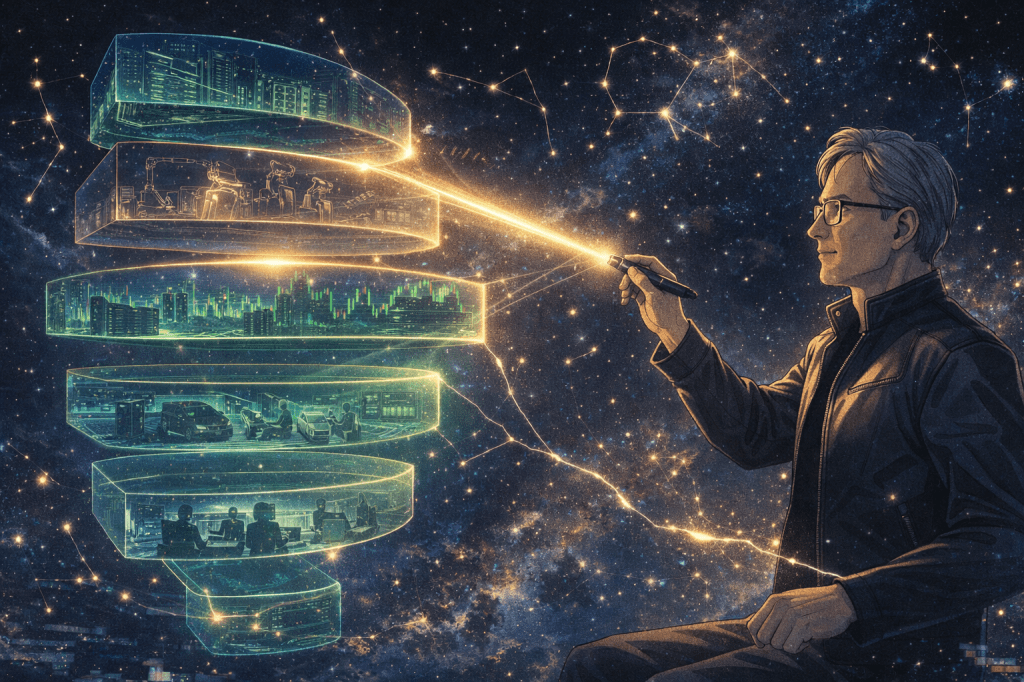
The Five-Layer Reality: Jensen Huang Redraws the Map of the AI Economy
Forget the chatbots for a second.
At Davos 2026, NVIDIA CEO Jensen Huang gave the AI industry a much-needed reset—and possibly its most important mental model yet.
In conversation with BlackRock CEO Larry Fink, Huang broke down what’s really happening behind the scenes: a capital-intensive revolution, powered by infrastructure spending on a scale we haven’t seen since the industrial age. It’s not about the next viral app. It’s about who builds the foundation that everything else will depend on.
Five Layers of AI That Actually Matter
According to Huang, AI isn’t a singular innovation—it’s a five-layer cake:
- Energy – The raw power source.
- Chips & Compute Infrastructure – Think NVIDIA GPUs, chip fabs, and hyperscale computing.
- Cloud Infrastructure – Data pipelines and hosting platforms.
- AI Models – LLMs, multimodal tools, foundational training systems.
- Applications – Where value is created: healthcare, finance, manufacturing, education.
“You can’t build the application layer without everything underneath it,” Huang explained. And those layers? They require trillions in global investment.
Infrastructure as Destiny
He cited real numbers. Taiwan Semiconductor (TSMC) is building 20 new chip fabs. Foxconn, Wistron, and Quanta are adding 30 new computer manufacturing facilities. Micron alone is committing $200 billion in the U.S.
And here’s the kicker: even two-generations-old GPUs are seeing price spikes and inventory shortages. That’s not a bubble. That’s demand outpacing global supply.
Huang’s point: AI is no longer about hype. It’s about industrial-scale infrastructure—and only those who build will benefit long-term.
From Code to Context: Teaching > Programming
What makes this era different? Previous software revolutions were built on structured databases and deterministic logic. You wrote rules, the computer followed them.
Today’s AI systems learn from unstructured environments—text, images, sound—and respond in real time.
“You don’t write AI. You teach AI,” Huang said. That single insight reframes the entire future of education, software development, and labor.
Three Inflection Points You Might’ve Missed
Huang highlighted three breakthroughs that made AI economically viable in the past year:
- Grounded Models – Better reasoning, less hallucination, actual reliability.
- Open Models – Tools like DeepSeek enabling organizations to build without starting from scratch.
- Physical Intelligence – AI is moving beyond language. It’s solving protein folding, simulating particle physics, and accelerating drug discovery.
“Proteins are essentially a language,” Huang noted, showcasing NVIDIA’s partnership with Eli Lilly as proof that AI is already transforming industrial R&D.
Europe’s Quiet Advantage
Asked about Europe’s role, Huang didn’t mince words: Europe has the industrial manufacturing base to lead in physical AI—but only if it upgrades its energy infrastructure. Without energy, no layer below the application stack is possible.
“You’ll either build infrastructure or become a perpetual consumer of someone else’s AI,” he warned.
VC Bets & Real-World Spillover
In 2025, VC funding into AI-native companies topped $100 billion. But this time, it wasn’t about LLM startups. The money went to application-layer plays in healthcare, robotics, fintech, logistics, and manufacturing.
And that demand? It’s already cascading down the stack—fueling the need for data centers, chips, and skilled workers.
Is This a Bubble or a Foundation?
Fink asked the big question: Is AI a bubble?
Huang’s reply was concrete: look at GPU spot prices. Look at cloud capacity. Look at who’s building and who’s buying. These are real signals, not speculative froth.
“This is the single largest infrastructure buildout in human history,” Huang said. “Get involved.
Congress Pushes Back: Trump’s Nvidia Chip Deal to China Sparks New Oversight Bill
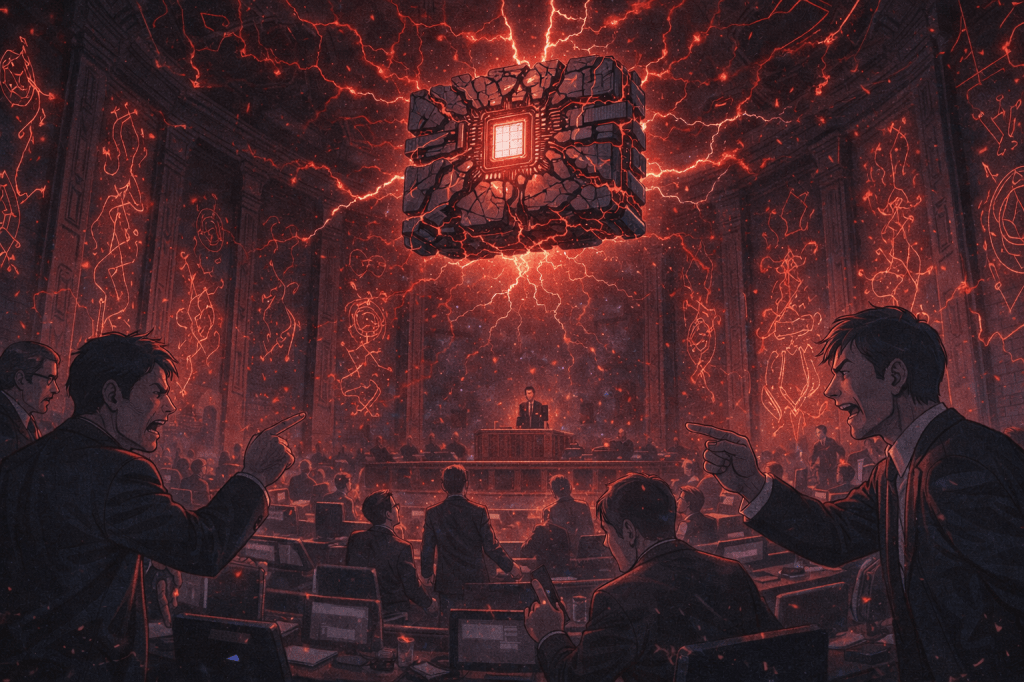
Just weeks after former President Trump gave the go-ahead for Nvidia’s cutting-edge H200 chips to be sold to China, Congress is moving to pull the emergency brake.
In a sharp rebuke, House Republicans are rallying around the AI Overwatch Act, a new bill designed to give lawmakers final authority over sensitive AI hardware exports—especially when adversarial countries are involved.
“This isn’t about Xbox or Halo,” said Rep. Brian Mast (R‑FL), who introduced the legislation and chairs the House Foreign Affairs Committee. “This is about national security and the future of AI dominance.”
Under the bill, sales of advanced AI chips like Nvidia’s H200 would be subject to a 30-day congressional review—mirroring the same process used for military aircraft, weapons systems, and defense tech.
Why It Matters: The AI Arms Race Just Got Political
The backdrop? A growing concern in Washington that selling next-gen AI accelerators to China could undermine U.S. technological superiority in artificial intelligence.
Representative John Moolenaar (R-MI), Chair of the House Select Committee on China, voiced his own concerns in a letter to the Commerce Department:
“I’m fully committed to President Trump’s AI vision, but giving China access to chips that leapfrog their current capabilities
Jamie Dimon vs. Jensen Huang: Two Visions for an AI-Powered Future

The future of artificial intelligence took center stage again at Davos—this time with two of the world’s most powerful executives offering radically different visions.
Jamie Dimon, CEO of JPMorgan Chase, issued a stark warning:
“AI may go too fast for society,” he said, urging governments and businesses to work together to avoid mass displacement and civil unrest.
While Dimon acknowledged AI’s upside—greater productivity, medical breakthroughs, economic growth—he warned that without support for displaced workers, the social cost could be devastating.
Case in point: The 2 million U.S. truck drivers facing replacement by autonomous vehicles.
“If they go from earning $150K a year to $25K overnight, that’s how you get unrest,” Dimon said. “This has to be phased in to protect society.”
His solution: public-private coordination to roll out retraining, relocation, wage support, and early retirement programs. Dimon made clear AI isn’t stoppable—but it must be managed.
Nvidia’s Jensen Huang: AI Will Create Jobs, Not Destroy Them
On the opposite side of the Davos stage, Nvidia CEO Jensen Huang was far more optimistic.
Rather than seeing job destruction, Huang framed the AI revolution as “the largest infrastructure buildout in human history,” one that’s already generating a massive wave of demand for trade workers—electricians, steelworkers, chip factory builders, data center techs, and network engineers.
“Energy, chips, and infrastructure are creating jobs—lots of jobs,” Huang emphasized. “This is a once-in-a-generation opportunity for Europe to leap past the software era.”
Huang pushed back on fears of automation by spotlighting the shortage of skilled labor, especially in the physical buildout of the AI economy. According to him, wages are already rising in these sectors—a sign of real-world demand, not mass layoffs.
So Who’s Right?
Dimon and Huang don’t disagree on AI’s impact—they disagree on the pace and strategy for rollout.
- Dimon is concerned about timing and social consequences.
- Huang believes the infrastructure boom will more than offset short-term pain.
Both leaders are shaping the next decade of economic and technological development—and both call for proactive planning, even if their tones differ.
Bottom line? Whether AI disrupts or delivers will depend on how society manages the rollout.
Mass adoption is inevitable. But inclusive design, reskilling, and infrastructure readiness are the difference between chaos and progress.
Inside Meta’s New Superintelligence Lab—and What’s Coming Next

After a turbulent year of restructuring, Meta’s bold bet on AI is starting to bear fruit.
At the World Economic Forum in Davos, Meta CTO Andrew Bosworth revealed that the company’s Meta Superintelligence Lab—launched just six months ago—has already delivered its first internal AI models, describing the early results as “very good.” While details remain sparse, the models are part of Meta’s broader push to leapfrog competitors in the hyper-competitive race for AI dominance.
Industry leaks have pointed to two key projects:
- “Avocado” — a next-gen text AI model, expected to launch in Q1.
- “Mango” — a multimodal image and video model, also in development.
Bosworth didn’t confirm which models were released internally, but made it clear that these tools are designed for real-world interaction and consumer integration, not just research.
“There’s a tremendous amount of work to do post-training to make models usable,” Bosworth said. “But we’re starting to see real returns from the chaos of 2025.”
Why It Matters
Meta spent much of last year in aggressive rebuild mode—restructuring teams, poaching AI talent with top-dollar offers, and investing heavily in power and infrastructure. This came in response to criticism over the performance of its Llama 4 model, as OpenAI, Google, and Anthropic surged ahead.
Now, Meta’s focus is on consumer AI—real products that make AI useful in everyday life. Bosworth emphasized that 2026 and 2027 will be pivotal for getting these tools into the hands of users.
Think AI that helps you:
- Ask daily questions with your family
- Interact via wearables (like Meta’s Ray-Ban smart glasses)
- Navigate both digital and physical environments with more natural interfaces
What’s Next for Meta AI?
Meta’s AI-powered Ray-Ban Display glasses are already on the market, though international expansion was paused to meet rising U.S. demand. This suggests Meta is refining its rollout strategy to focus on adoption, user feedback, and performance tuning before scaling globally.
Meanwhile, the Meta Superintelligence Lab is expected to push even deeper into multimodal AI, a space where language, vision, and audio models converge.
If Meta delivers here, we’re looking at AI that isn’t just smart—it’s perceptive, interactive, and ambient.
Meta’s AI reboot is gaining momentum. With infrastructure in place and early models already in the wild, the next two years could define whether Meta becomes a serious AI powerhouse—or just another contender playing catch-up.
Crypto
The Point of No Return: Crypto Is No Longer Optional for Institutions

According to PwC’s latest Global Crypto Regulation Report 2026, the age of crypto as a speculative playground is officially over.
The firm’s key message is clear: institutional adoption of crypto has passed the point of no return.
What once lived on the fringes of finance—digital tokens, stablecoins, and onchain rails—has now quietly woven itself into the core operating systems of global money movement.
“Institutional involvement has crossed the point of reversibility,” the report states, referencing growing use cases across payments, treasury, settlement, and balance-sheet management.
This is no longer about chasing token gains. It’s about operational infrastructure.
Stablecoins: From Fringe Tool to Financial Backbone
Behind the scenes of global finance, stablecoins and tokenized cash are already working overtime.
- Banks and asset managers are using tokenized dollars for cross-border transfers and internal treasury moves.
- Major networks like Visa and Mastercard are quietly processing settlement volumes through stablecoin rails.
- Traditional finance (TradFi) isn’t debating if it should use blockchain—it’s figuring out how fast it can scale.
Circle CEO Jeremy Allaire underscored this shift at Davos, noting a “reasonable baseline” of 40% compound annual growth in stablecoin adoption. According to Allaire, financial institutions aren’t piloting anymore—they’re implementing.
“In the short, medium, and long term, everybody has to participate in the technology.”
From Front-End Trading to Back-End Utility
PwC and ARK Invest both highlight the same evolution: crypto is shifting from speculative use to embedded infrastructure.
No longer confined to exchanges or trading apps, digital assets now power the back-end functions of global finance.
This includes:
- Treasury management
- Cross-border settlements
- Tokenized banking services
- Digital wallets integrated into consumer apps
ARK’s Big Ideas 2026 report describes this era as “deployment mode”—public blockchains are no longer experimental. They are becoming default rails for money movement, just as cloud computing became the default for software.
Why It Matters
For investors, builders, and policymakers, the message is clear:
- The rails are being laid now.
- The infrastructure is maturing quietly, behind the scenes.
- Legacy and blockchain finance are converging.
You may not “see” crypto in your day-to-day transactions yet—but it’s already moving the money behind them.
Crypto’s role in institutional finance is no longer a thesis. It’s an operating fact. And unwinding it may no longer be possible—or desirable.
USD.AI Just Approved $500M in GPU-Backed Loans for AI Infrastructure. Here’s Why That Matters

The convergence of blockchain finance and AI infrastructure just got real.
USD.AI, an onchain protocol acting as a decentralized bank for AI startups, has greenlit a $500 million debt facility for Sharon AI, an Australia-based infrastructure firm. The goal: scale GPU deployments across the Asia-Pacific region without relying on outdated legacy financial rails.
How It Works: Tokenized GPUs as Collateral
USD.AI operates on a radically simple but powerful principle—finance AI startups by letting them post tokenized GPU assets as collateral.
Instead of waiting months for bank approvals or diluting equity, AI companies can now tap onchain liquidity by pledging physical infrastructure.
- Borrowers pledge verified GPU assets
- Those GPUs are tokenized onchain, establishing a direct link between deployed compute and capital access
- USD.AI only lends against these verified assets, minimizing exposure
This approach “isolates risk at the infrastructure level,” enabling non-recourse financing that’s faster and more transparent than traditional channels.
Why Sharon AI Matters
Sharon AI isn’t just another AI startup—it’s targeting hyperscale compute, supporting enterprise, research, and even government clients across Australia and Asia. Their co-founder James Manning called USD.AI’s model “market leading” and confirmed they’ll begin tapping into the loan this quarter, starting with $65 million in GPU expansion.
For context, USD.AI has already approved over $1.2 billion in non-recourse lending to AI firms, including QumulusAI and Quantum Solutions. This is no pilot project—this is scale in motion.
The Bigger Picture: A New Model for AI Financing
The AI boom is straining traditional capital markets. Banks move too slow, equity dilution kills growth, and hardware demand far outpaces traditional financing cycles.
USD.AI fills that gap—creating an onchain bridge between capital and compute.
Their dual-token system includes:
- USDai (a stablecoin for borrowing)
- sUSDai (a staked, yield-bearing version for lenders)
This design incentivizes long-term liquidity provision, while keeping the system collateralized with real-world GPU assets—tokenized proof-of-compute.
Why This Matters for the Future of Web3
This isn’t a meme coin. This isn’t NFT speculation.
This is Web3 capital infrastructure funding the real economy—specifically, the AI buildout of the 2020s.
When onchain protocols like USD.AI can deploy hundreds of millions to hardware-intensive industries, it signals a new chapter for blockchain utility:
- Programmable finance meets high-value infrastructure
- DeFi tools meet real-world cash flow and asset tokenization
- Global capital flows without gatekeepers
Expect this trend to accelerate as demand for decentralized AI compute scales up—and the traditional system fails to keep pace.
Crypto Market Structure Bill Advances—but Without Bipartisan Unity
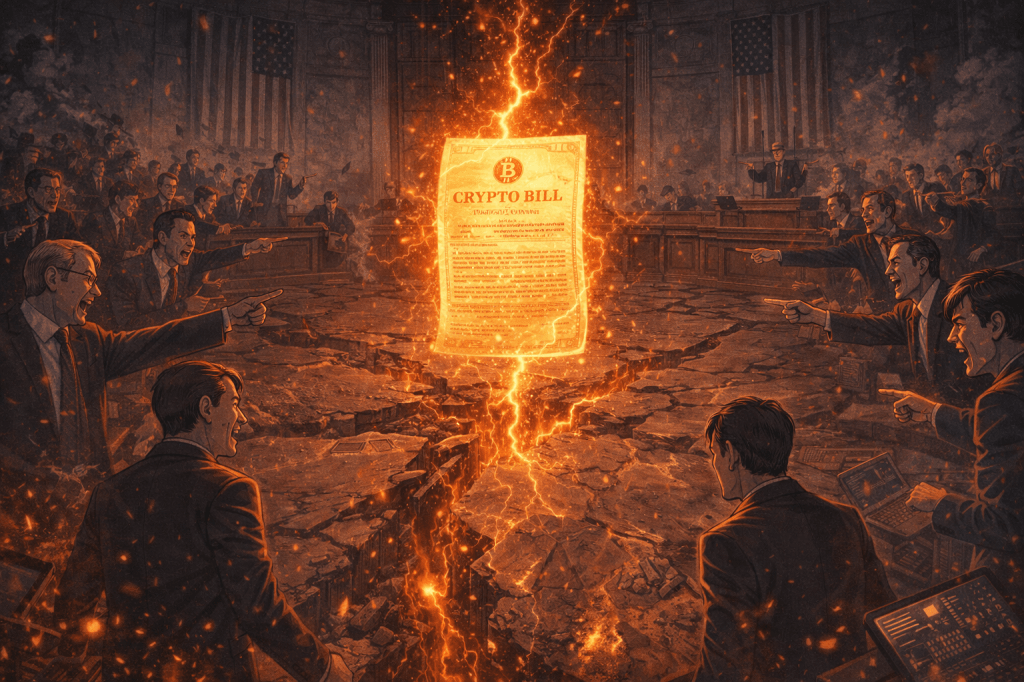
Senate Agriculture Chair John Boozman has released an updated draft of his crypto market structure bill, marking the most tangible movement in months on Capitol Hill. But instead of delivering a bipartisan breakthrough, this version could entrench political fault lines that delay any true consensus.
Here’s what it means and why it matters:
What’s in the New Bill
The January 21st text builds on the previous Boozman–Booker framework, but noticeably lacks Senator Cory Booker’s endorsement—a sign that the bipartisan momentum may have stalled.
Key features of the new draft:
- CFTC-led framework: The bill would give the Commodity Futures Trading Commission expanded oversight of digital commodity spot markets
- “Meme coins” included by default in the definition of digital commodities—unless the CFTC explicitly rules them out
- New registration pathways for crypto exchanges, brokers, and dealers
- Expedited onboarding with provisional licenses for market players while full rulemaking unfolds
- Developer protections: Non-custodial software builders and interface providers are shielded from being regulated as intermediaries—an important clause for DeFi and open-source devs
What’s Missing: DeFi & AML Frameworks
The earlier version of the bill had dedicated sections on DeFi and anti-money laundering. Those explicit headings are now gone. Instead, those issues are buried deeper in definitional language—setting the stage for future fights over what tools and protocols might fall under federal scrutiny.
What Happens Next
- A formal markup vote is scheduled for January 27
- If passed, this version becomes Senate Agriculture’s official position going into future negotiations
- But without Booker’s backing, Senate Banking could see it as a rival text rather than a compromise vehicle
- That raises the stakes for whether two powerful Senate committees can align or stall into cross-committee gridlock
Meanwhile, Senate Banking’s own progress on H.R. 3633 remains postponed, and it’s unclear whether a new bipartisan path can emerge.
Developer Takeaway: Regulatory Risk Isn’t Dead, But It’s Evolving
For builders, the most important part of the Boozman update is the language shielding developers from being automatically treated as intermediaries. If that holds, open-source developers, non-custodial wallets, and protocol maintainers may be able to operate without being pulled into full-blown compliance regimes—a huge win for DeFi and public infrastructure.
However, without a clear AML framework or cross-agency coordination, risk still looms for dApp frontends and service providers that might trigger enforcement under existing laws.
Market Read: Regulations Are Now Price-Sensitive Events
CoinShares reported $2.17 billion in crypto inflows the week of Jan. 19, following a previous $454 million in outflows. Sentiment is swinging fast, and regulatory developments like this bill can impact capital flows as much as macroeconomic signals.
With the CFTC likely to get new authority, and the SEC stepping back from major status fights, the market structure fight is shifting—but not over.
What to Watch
- Jan. 27 markup: If the bill clears committee, it becomes the starting point for new negotiations or gridlock
- Stablecoin rules & AML clarity: Neither have been resolved here. Expect new legislation or regulatory guidance in parallel
- Senate Banking’s next move: Will they engage or delay further?
- Builder community response: How developer protections hold up in final language will determine how safe it is to launch new projects
Ripple’s RLUSD Stablecoin Hits Binance—But Is It Built to Last?
On Jan. 22, Binance—the world’s largest crypto exchange—officially listed RLUSD, Ripple’s new stablecoin. But this isn’t just another pair on the books. With zero trading fees on RLUSD/USDT and RLUSD/U pairs, Binance has made its intentions clear: this isn’t about participation—it’s about dominance.
And the implications go far beyond the surface.
Why This Listing Actually Matters
At a glance, it’s just another stablecoin going live. But under the hood, Binance is engineering a liquidity flywheel—the same playbook it used in 2023 to supercharge USDC adoption. Zero fees drive volume. Volume attracts tighter spreads, better execution, and more market maker interest. That builds momentum. Momentum builds narrative.
If enough liquidity reroutes through RLUSD, Ripple’s stablecoin could become a top-three asset—without ever chasing retail hype.
Two Flywheels Ripple Needs to Win
- Routing Adoption
Binance is incentivizing deep RLUSD liquidity. With tighter spreads and lower slippage, RLUSD becomes a “better rail” to move capital. This encourages traders to route through it even if they’re not consciously choosing RLUSD.
It’s the same reason we use the fastest highway—not because we love the brand, but because it gets us where we want to go. - Balance Sheet Adoption
Real growth comes when RLUSD isn’t just traded—it’s held. As exchange collateral, in DeFi lending markets, or by institutions managing treasury balances. Binance is setting the stage by making RLUSD margin-eligible and preparing it for Binance Earn, which will give holders yield-based incentives.
Can RLUSD Climb the Ranks? Let’s Talk Numbers.
- RLUSD has $1.4B in circulation, sitting somewhere in the top 10.
- To enter the top 3, it must reach over $6.5B, surpassing Ethena’s USDe.
- That means adding $424M per month in new issuance over the next 12 months.
It’s a steep hill, but broader tailwinds could help:
- The US Treasury sees $3 trillion as a potential stablecoin market cap by 2030.
- JPMorgan forecasts $2 trillion within two years in a bullish scenario.
In that context, RLUSD doesn’t have to steal market share—it just needs to ride the wave.
Ripple Is Playing an Institutional Game
The real power move here isn’t the Binance listing. It’s Ripple’s institutional strategy:
- RLUSD is issued under a New York DFS trust charter, with OCC approval in the works.
- Ripple has acquired prime brokerages, custody platforms, and treasury providers, quietly building an infrastructure stack that goes far beyond exchanges.
- This moves RLUSD into the heart of multi-asset collateral networks, cross-border payments, and institutional liquidity loops.
If you’re thinking like a treasury desk or compliance officer, this is less about crypto speculation and more about regulated capital flows.
But Here’s the Catch: Volume ≠ Adoption
Liquidity can be manufactured. Real adoption can’t.
- Binance’s spot market volumes are down—just $367B in Dec. 2025, the lowest since Sept. 2024.
- That means the RLUSD rollout is happening during a cooldown.
So the big question is: Will RLUSD become the cheapest stablecoin to use—or one that institutions actually hold?
Bottom Line: Watch RLUSD’s Supply, Not Just Volume
A surge in RLUSD trading is expected. But unless we see steady growth in circulating supply, it’s just noise.
The real signal?
- Institutional wallets holding RLUSD
- DeFi protocols adopting it
- Real-world use in treasury, payments, and settlement systems
If that happens, we’re not just witnessing a listing—we’re watching the emergence of a new power player in the stablecoin race.
Ethereum’s Activity Spike? Wall Street Says It’s a Scam Surge, Not Real Growth

Ethereum just posted a record-breaking rise in daily transactions and active addresses—but don’t let the numbers fool you. According to a new report from Citi, the surge is likely fueled by “address poisoning” scams, not a wave of new users or apps.
What’s Really Going On?
Here’s the breakdown:
- Many of the new transactions are under $1 in value—a classic hallmark of scam behavior.
- Scammers are exploiting Ethereum’s low gas fees to send tiny amounts of crypto from wallet addresses that look similar to real ones you’ve interacted with.
- The goal? To trick users into accidentally copying and pasting the fake address in future transfers—sending their money to the wrong wallet.
This tactic bloats on-chain metrics, giving the illusion of network growth. But in reality, it’s a smoke screen.
Stablecoins Driving the Spike—But Not Organically
Onchain researcher Andrey Sergeenkov dug deeper:
- Over 80% of the new Ethereum address activity came from stablecoin transactions.
- Many of these are automated smart contracts sending sub-$1 USDT or USDC transfers to thousands of addresses at once—classic infrastructure for poisoning campaigns.
It’s not demand. It’s deception.
What About Price Action?
Despite the on-chain flurry, ETH’s price has underperformed BTC so far this year:
- Bitcoin is up ~2.4%, holding steady.
- Ethereum is flat, with more volatility.
Even JPMorgan chimed in this week, saying Ethereum’s recent uptick in activity after the Fusaka upgrade likely won’t last, especially with layer-2s and rival chains stealing market share.
Real Growth Leaves a Different Footprint
More activity doesn’t always mean more value.
- When it’s built on malicious behavior, inflated metrics become a trap.
- Smart money watches what’s being built, not just what’s being counted.
If you’re in this space to understand signal vs noise, Ethereum’s latest burst is a reminder: Not all spikes are bullish.
Tennessee Embraces Bitcoin—One Zoning Code and One Bill at a Time

Crypto isn’t just a market—it’s becoming part of the local infrastructure. This week, Kingsport, Tennessee took a step that could reshape how small cities position themselves in the digital economy. And that’s not all—state lawmakers are eyeing Bitcoin for their treasury.
Zoning In on Crypto Mining
The Board of Mayor and Aldermen in Kingsport just gave a unanimous thumbs-up to the first reading of a zoning ordinance that would open the city to crypto miners and data centers—but with rules.
Here’s what’s in the amendment:
- Only allowed in industrial zones
- Must be inside a fully enclosed building
- Must be at least 500 feet away from any residential property
- Noise capped at 60 dBA from the property line—yes, they’re already thinking about those noisy rigs
Why this matters: Kingsport’s planning staff is looking ahead, recognizing that data-driven industries will demand new infrastructure. This ordinance is a clear signal that crypto and digital compute centers are no longer fringe—they’re considered economic drivers.
State-Level Signal: Bitcoin on the Balance Sheet?
While Kingsport plans for mining noise, the Tennessee House of Representatives is thinking bigger.
Rep. Jody Barrett just introduced the Tennessee Strategic Bitcoin Reserve Act, which would allow the state to invest up to 10% of its general fund in Bitcoin.
If passed, the bill would take effect July 1—and Tennessee would become one of the first U.S. states to formalize Bitcoin as a strategic treasury asset.
Why This Matters
Tennessee is rapidly becoming one of the most crypto-progressive states in the U.S.:
- CleanSpark’s expansion in Knoxville already signaled miner interest
- Now cities like Kingsport are creating zoning clarity
- And state lawmakers are exploring Bitcoin as a reserve asset, not just a speculative bet
This isn’t hype—it’s long-term infrastructure.
The Bigger Picture
For blockchain builders, investors, and data infrastructure providers, these two developments show how crypto is threading into civic and economic strategy—not just tech headlines.
Zoning codes and treasury allocations may sound dry, but they’re the legal and fiscal skeletons of future crypto adoption.
Crypto isn’t just knocking on the door anymore—it’s getting the keys to the city.
 Powerbuilding Digital