
Fitness / Motivation / Technology & A.I / Crypto

Welcome to Edition 114 of the Powerbuilding Digital Newsletter—your weekly blueprint for strength, mindset, innovation, and growth. Whether you’re here to refine your training, expand your thinking, or stay ahead in the digital world, this is where discipline meets discovery.
Here’s what’s inside this week:
- Fitness Info & Ideas
Tried-and-true training methods mixed with modern performance insights—everything you need to build strength that lasts. - Motivation & Wellbeing
Mental focus is your strongest muscle. Learn how to recharge, reset, and stay consistent through life’s pressure points. - Technology & AI Trends
From cutting-edge AI tools to shifts in tech that are reshaping entire industries, we cover what’s relevant and ready for real-world impact. - Crypto & Digital Asset Trends
No charts, no hype—just practical innovations, emerging apps, and blockchain use cases shaping the next wave of Web3 adoption.
Edition 114 is about balance—training hard, thinking smart, and adapting fast. Stay focused, stay curious, and let’s keep building the future—one rep, one insight, one move at a time.
Fitness
The Power of Accessory Lifts: Build Bigger Numbers on Compound Moves

Everyone loves to chase big numbers on the barbell—squats, bench press, and deadlifts are the crown jewels of strength. But the truth is, your progress on those lifts isn’t just built by doing more of them. It’s built by the work behind the work—the accessory lifts that strengthen weak links, improve control, and build muscle where it matters most.
If you want to lift heavier, look better, and stay injury-free, your accessories are non-negotiable.
What Are Accessory Lifts?
Accessory lifts are supporting exercises that strengthen the muscles, patterns, or positions involved in your main compound movements. They target weaknesses, improve muscle balance, and reinforce technique.
Examples:
- Romanian Deadlifts (for posterior chain strength)
- Close-Grip Bench Press (for triceps and lockout)
- Front Squats (for quads and upper-back stability)
Why Accessory Lifts Matter for Strength and Growth
You can’t build a skyscraper on a weak foundation. Accessory lifts fill the gaps that heavy barbell work can’t fully address:
- Muscle imbalances
- Weak stabilizers
- Limited range of motion
- Poor control under fatigue
They’re also your best friend for joint longevity—helping prevent the overuse injuries that come from hammering the same lifts week after week.
The Relationship Between Compound and Accessory Work
Think of it like this:
- Compounds = performance drivers
- Accessories = performance enablers
Your main lifts test strength. Your accessory lifts build it.
The Science of Weak Point Training
Research from the Journal of Strength and Conditioning Research shows that addressing specific movement phases (like the bottom of a squat or the lockout in a bench) leads to faster overall improvement in compound lift performance.
Accessory lifts let you isolate and strengthen these sticking points.
How Accessory Lifts Improve Muscle Imbalance and Stability
Every compound movement has prime movers and stabilizers. Over time, the prime movers get strong—but the stabilizers can lag behind. Accessory work bridges that gap, enhancing joint integrity and coordination.
Example:
- Weak glutes in a squat cause knee cave.
- Weak lats in a deadlift limit lockout.
- Weak triceps in a bench cause bar stalls halfway up.
Common Accessory Lifts for Each Main Movement
Squat Accessories
- Front Squat – Builds upper back and quads
- Bulgarian Split Squat – Single-leg strength and balance
- Good Mornings – Posterior chain and hip hinge strength
- Leg Press / Lunges – Volume work for hypertrophy
Bench Press Accessories
- Close-Grip Bench – Triceps strength for lockout
- Pause Bench – Stability and control off the chest
- Overhead Press – Shoulder and upper-body balance
- Dumbbell Press – Corrects left/right imbalances
Deadlift Accessories
- Romanian Deadlift – Hamstring and glute development
- Deficit Deadlift – Improves off-the-floor strength
- Rack Pulls – Focus on lockout power
- Barbell Rows – Lat and upper-back support
Accessory Lifts for Shoulder, Core, and Grip Strength
- Shoulders: Face pulls, lateral raises, band pull-aparts
- Core: Weighted planks, hanging leg raises, ab rollouts
- Grip: Farmer’s carries, plate pinches, towel pull-ups
A strong core and grip make every lift more stable, more controlled, and ultimately stronger.
How to Identify Your Weak Points
Ask yourself:
- Where do I fail in the lift? (bottom, midpoint, or top)
- Which muscles fatigue first?
- What do I struggle to feel working?
Film your lifts, review your form, and train the weak zone—not just your favorite one.
Programming Accessory Work Effectively
General rule: 2–4 accessory exercises per session, focused on weaknesses or balance.
Example:
- Main lift (Squat 5×5)
- Accessory 1 (Front Squat 3×8)
- Accessory 2 (Bulgarian Split Squat 3×10)
- Accessory 3 (Glute Ham Raise 3×12)
Volume and Intensity Guidelines
- 60–75% of 1RM for strength-focused accessories
- 65–80% for hypertrophy
- 2–4 sets of 8–15 reps (depending on goal)
Accessory Lifts for Hypertrophy vs. Strength
- For hypertrophy: Moderate weight, higher reps, shorter rest (45–90 sec)
- For strength: Heavier weight, lower reps, longer rest (2–4 min)
The Role of Tempo and Range of Motion
Tempo work increases time under tension and reinforces control. Examples:
- 3-1-1-0 squats for stability
- Paused bench for tightness and precision
- Slow eccentric RDLs for hamstring hypertrophy
Sample Powerbuilding Accessory Templates
Upper Day (Bench Focus)
- Bench Press 5×5
- Close-Grip Bench 3×8
- Overhead Press 3×10
- Dumbbell Row 4×10
- Face Pulls 3×15
Lower Day (Squat/Deadlift Focus)
- Squat 5×5
- Romanian Deadlift 3×8
- Bulgarian Split Squat 3×10
- Leg Curl 3×12
- Planks 3x60s
Common Mistakes Lifters Make With Accessories
- Treating them as “optional”
- Doing too many and killing recovery
- Copying influencers instead of addressing personal weak points
- Using poor form with lighter weights
How to Progress Accessory Movements Over Time
- Add 2–5 lbs weekly
- Increase reps slightly
- Add pauses or tempo changes for variety
- Track metrics like range of motion and stability, not just load
Long-Term Benefits of Balanced Training
Accessory work builds:
- Joint health
- Longevity
- Aesthetic balance
- Confidence in every phase of the lift
The best lifters aren’t just strong on paper—they’re strong through every angle and position.
Conclusion: Build the Foundation Beneath Your Strength
Big lifts get the spotlight—but accessory lifts build the stage. They make your compound moves smoother, stronger, and more resilient.
Don’t skip the foundation. The stronger your base, the higher your ceiling. Master your accessories, and your main lifts will follow.
Sources
- NSCA Strength and Conditioning Guidelines
- Zatsiorsky, V.M. – Science and Practice of Strength Training
- Schoenfeld, B.J. – Science and Development of Muscle Hypertrophy
- Journal of Strength and Conditioning Research – Weak Point Training Studie
Motivation
From Stagnant to Driven: How to Rebuild Motivation After Burnout

Burnout isn’t weakness—it’s feedback. It’s your body and mind saying, “You’ve been giving too much without recharging enough.” In a world obsessed with constant output and productivity, slowing down feels like failure. But in truth, recovery is part of the process.
If you’ve lost your drive, this isn’t where your story ends. It’s where you rebuild—with more clarity, strength, and purpose than before.
Understanding Burnout: The Hidden Cost of Pushing Too Hard
Burnout happens when prolonged stress and pressure outpace your recovery capacity. You’re not just tired—you’re emotionally drained, mentally detached, and physically flat.
The World Health Organization defines burnout as “chronic workplace stress that has not been successfully managed.” But it applies to athletes, entrepreneurs, and anyone driven by ambition.
The Science Behind Motivation Fatigue
Research from Stanford University shows that motivation isn’t infinite—it’s tied to dopamine regulation, sleep, and energy balance. When those systems crash, your drive follows.
The solution isn’t to grind harder—it’s to rebuild the system that fuels motivation in the first place.
Signs You’re Not Lazy—You’re Burned Out
- You dread tasks you used to enjoy
- Small decisions feel exhausting
- You’ve lost interest in training, work, or goals
- You feel numb instead of tired
- You oscillate between overworking and complete withdrawal
The Difference Between Rest and Avoidance
There’s a difference between resting to recover and numbing out to escape. True rest restores energy; avoidance deepens burnout.
Ask yourself: Does this recharge me or just distract me?
Step 1: Acknowledge, Don’t Deny
You can’t rebuild what you won’t face. Admitting burnout isn’t weakness—it’s awareness. The longer you deny it, the more it festers.
Acceptance is the first form of control.
Step 2: Reconnect With Your “Why”
Burnout often disconnects you from purpose. Go back to the beginning—why did you start? Why did this matter in the first place?
Write it out. Speak it aloud. Your “why” is your emotional compass when logic fails.
Step 3: Simplify and Reset Expectations
Burnout thrives on overwhelm. Simplify your inputs:
- Cut non-essential goals
- Stop overcommitting
- Focus on one priority per day
Remember: momentum starts small.
Step 4: Rebuild Routine Through Small Wins
You don’t need to overhaul your life—you just need momentum.
- Start training twice a week instead of five
- Spend 15 focused minutes on deep work
- Stack habits instead of forcing massive change
Small wins rebuild confidence. Confidence rebuilds drive.
Step 5: Recharge Physically and Mentally
Sleep, nutrition, and active recovery are your base.
- 7–9 hours of consistent sleep
- Protein, hydration, and micronutrients to restore energy
- Meditation or nature walks for nervous system balance
Your drive can’t return if your body is still running on empty.
Step 6: Change Your Environment to Reignite Energy
Environment shapes emotion.
- Train in a new gym
- Work from a different space
- Surround yourself with people who elevate, not drain, your energy
A new setting can signal a new start.
Step 7: Reintroduce Structure Without Rigidity
Burnout often comes from over-structure—a rigid system with no room for flexibility.
Build routines that support you but allow freedom:
- Schedule focus blocks and breaks
- Plan workouts with recovery in mind
- Leave space for play, not just progress
Step 8: Learn to Work With, Not Against, Your Energy Cycles
Everyone has natural peaks and dips in energy.
- Use high-energy hours for deep work
- Use low-energy hours for reflection, mobility, or lighter tasks
Mastering your rhythm is smarter than forcing constant output.
The Role of Purpose and Passion in Long-Term Drive
Purpose reignites passion. When your goals align with your values, effort stops feeling forced. You’re not chasing external validation—you’re living from internal meaning.
How to Protect Against Future Burnout
- Prioritize recovery as much as work
- Set firm boundaries with time and energy
- Check in with yourself weekly (journal, reflection)
- Redefine success as sustainable performance, not endless output
Common Mistakes When Trying to “Force” Motivation
- Jumping back too fast without rest
- Comparing yourself to your old output
- Using guilt as motivation instead of purpose
- Ignoring emotional fatigue while “pushing through”
Real-World Examples of Rebuilding Drive
- Athletes: After overtraining, periodization and strategic deloads restore long-term progress.
- Entrepreneurs: Cutting nonessential projects and returning to their mission rekindles clarity.
- Everyday Lifters: Shifting from ego-based goals to mastery-based goals revives joy in training.
Conclusion: Burnout Isn’t the End—It’s a Reset
Burnout strips away what’s unsustainable, leaving only what’s real. It’s not the end of your drive—it’s the moment you rebuild it, stronger and smarter.
When the fire burns out, don’t chase sparks—rebuild the foundation.
Rest, reset, realign—and rise again.
Sources
- Maslach, C. – The Truth About Burnout
- Stanford University – Motivation and Dopamine Studies
- Journal of Behavioral Health – Recovery and Resilience Research
- Duckworth, A. – Grit: The Power of Passion and Perseverance
Technology & A.I
Zendesk Debuts AI Support Agents Aiming to Eliminate 80% of Human Tech Intervention

At its recent AI summit, Zendesk unveiled a powerful new suite of LLM-driven support agents designed to drastically reduce the need for human technicians. Leading the rollout is an autonomous support agent that the company says can resolve 80% of customer support issues without human help.
The broader AI system includes:
- A co-pilot agent that assists with the remaining 20%
- An admin-layer agent to manage configurations
- A voice agent for spoken interactions
- An analytics agent built on Zendesk’s recent Hyperarc acquisition
Why This Matters
This marks a serious leap in enterprise AI—moving beyond chatbots and basic knowledge retrieval into true automation of customer support workflows. Zendesk’s president of Product, Engineering, and AI, Shashi Upadhyay, put it plainly:
“The world’s going to shift from software that’s built for human users, to a system where AI actually does most of the work.”
Independent benchmarks support the ambition. On TAU-bench, a tool-calling test designed for real-world scenarios like product returns, Claude Sonnet 4.5 leads the pack—resolving 85% of tasks, which mirrors Zendesk’s goal.
Strategic AI Acquisitions Fuel the Shift
Zendesk’s AI overhaul didn’t happen overnight. Since a rocky investor dispute in 2022, the company has made a series of strategic acquisitions to pivot toward agent-based automation:
- Klaus – Quality assurance and agentic systems (Feb 2024)
- Ultimate – Automation for support workflows (Mar 2024)
- Hyperarc – Advanced analytics (Jul 2025)
These tools now underpin Zendesk’s Resolution Platform, which already handles 4.6 billion support tickets annually across 20,000 customers.
Real-World Results & What’s Next
In pilot programs with existing clients, Zendesk says customer satisfaction has jumped by 5 to 10 points—a strong early indicator of AI’s potential to improve both CX (customer experience) and cost efficiency.
While many companies—from Airbnb to Regal Theaters—have dabbled in AI chat support, Zendesk’s latest push goes a step further: self-directed, action-taking AI agents embedded into full workflows.
The Bigger Picture
The U.S. alone employs over 2.4 million customer service reps. If this level of automation gains traction, the ripple effect across global labor markets, CX departments, and enterprise software design could be massive.
AI Isn’t the Future Risk—It’s the Current Breach Point

For years, CISOs treated AI as “emerging tech”—something to watch, not something to worry about. But a new report from browser security company LayerX makes one thing clear: AI is already the #1 channel for corporate data leaks, outpacing shadow SaaS and file-sharing platforms.
The Leak Is Happening Right Now
LayerX’s enterprise telemetry shows 45% of employees are actively using generative AI tools like ChatGPT, Claude, and Copilot—often through unmanaged personal accounts. That’s 67% of AI activity happening completely outside enterprise visibility.
It’s not theoretical anymore—this is data exfiltration at scale, through copy/paste, uploads, and prompts that slip past legacy security tools.
🔍 40% of files uploaded to GenAI tools contain PII or PCI data.
✂️ Copy/paste is the primary breach vector—77% of employees paste data into AI tools, and 82% of that activity comes from unmanaged accounts.
📎 Employees paste sensitive content into GenAI platforms an average of 3 times per day via personal accounts.
These are not edge cases—they’re daily workflows.
The Security Stack Is Focused on the Wrong Fight
Most security programs still operate under a file-centric DLP model—scanning for attachments, blocking unauthorized downloads, or logging file shares. But AI breaches don’t ride attachments. They move through prompts, snippets, chats, and personal tabs inside a browser.
The problem is action-based, not file-based. And traditional tools aren’t watching.
Identity ≠ Control
Even corporate logins are misleading. 71% of CRM logins and 83% of ERP logins are non-federated, making corporate accounts functionally no different than personal ones. Security leaders can’t assume “work login” means “secure session.”
Instant messaging apps are another blind spot. 87% of enterprise chat usage is through unmanaged accounts, and 62% of those chats contain sensitive data. Combine that with GenAI traffic, and the browser becomes the new perimeter.
4 Strategic Shifts CISOs Must Make Now
LayerX’s report doesn’t just outline the problem—it calls for a radical mindset shift. Here’s what security leaders should start doing immediately:
- Stop calling AI “emerging.”
AI needs to be governed with the same urgency as email or storage. - Move from file-centric to action-centric DLP.
Copy/paste, prompts, and snippets are now primary vectors. Treat them as such. - Ban unmanaged accounts or enforce hard federation.
Personal logins = zero visibility. Either block them or apply strict context-aware controls. - Prioritize high-risk categories.
GenAI, chat, and file storage tools require next-level governance—they carry both high adoption and high data sensitivity.
AI Isn’t Just a Productivity Shift—It’s a Governance Crisis
We’re witnessing an invisible collapse of enterprise data boundaries, happening quietly inside browsers and unsanctioned apps. The faster AI integrates into everyday work, the wider the gap grows between usage and control.
Security teams that treat AI as an edge case are already behind. The real battlefield is your browser—and the war is already underway.
For CISOs and security leaders looking to regain visibility, the full LayerX report is a must-read. It details real-world breach pathways, high-risk behaviors, and actionable frameworks for governing AI-driven workflows. The message is clear: adapt now—or get breached later.
Cisco’s New AI Chip Aims to Turn Data Centers Into One Giant Computer

Cisco Systems has unveiled a powerful new silicon chip, the P2 100, designed to interconnect data centers and unify them into a single logical AI supercomputer—a move aimed squarely at scaling next-gen AI workloads.
“We’re moving beyond chatbots,” said Cisco President Jeetu Patel.
“The future is autonomous agents doing real jobs—and that requires infrastructure that can think and scale like one massive system.”
The Vision: Interconnected AI Infrastructure
Cisco’s P2 100 chip and accompanying router systems are engineered to create a seamless mesh between AI data centers. The goal? Make physically separate centers behave like a unified compute system, capable of running massive models and orchestrating distributed inference workloads in real-time.
✅ 65% more energy efficient than current alternatives
✅ Distributed power draw = lower strain on single locations
✅ Built for large, compute-heavy AI jobs
This interconnectivity could redefine how large language models (LLMs) and generative agents are trained, hosted, and deployed—especially as we transition from simple prompt-based chatbots to autonomous agents executing multi-step tasks.
The Stakes: Jobs, Infrastructure, and Adaptation
A recent Elon University study found that over 50% of Americans already use AI tools, and 59% believe AI will significantly disrupt jobs, even accounting for new roles created.
Cisco’s Patel agrees that workforce disruption is real—but sees it as a call to action:
“Every job will be reconfigured by AI in some way.
We need to upskill the workforce—at scale—to meet that reality.”
Why This Matters
The P2 100 chip isn’t just a new piece of hardware—it’s a signal that AI-scale infrastructure is shifting from centralized to distributed architectures, with interoperability, energy efficiency, and agent-ready performance as the key pillars.
As models become more complex and agentic systems take center stage, infrastructure must evolve to match. Cisco is making a bet that unified compute across data centers is the way forward—and this could set the tone for how hyperscalers, enterprises, and sovereign AI platforms are built over the next decade.
Crypto
Coinbase Expands Decentralized Trading to U.S. Retail Base

Coinbase has launched decentralized trading access for nearly all U.S. customers, marking a major step in its push toward integrated, on-chain finance.
As of October 8, Coinbase users can now access non-custodial token swaps directly within the main Coinbase app, with the exception of New York residents due to regulatory restrictions. This expands a feature previously limited to beta testers—and opens up early asset access and real-time swaps for mainstream users.
What It Does: Early Access, Full Control
The in-app decentralized exchange (DEX) is powered by Base, Coinbase’s Ethereum Layer-2 network, and supports token trading the moment new projects go live—well before centralized listings catch up.
🔹 Supports Base-native tokens like Virtuals AI, Reserve DTFs, Auki Labs, and more
🔹 Built on 1inch and 0x routing for deep liquidity
🔹 No wallet handoffs—users keep full control
🔹 Gas fees covered by Coinbase in exchange for a transparent trading fee
🔹 Trades funded via Coinbase balance or USDC
This move signals more than convenience—it’s a shift toward seamless CeDeFi integration where decentralized trading becomes a native feature of centralized platforms.
The Bigger Picture: Centralized Exchanges Embrace the DEX Model
Coinbase isn’t alone. Other major CEXs are racing to build similar offerings:
- Bybit launched Byreal, a Solana-based DEX with centralized efficiency
- BitMart and MEXC have each rolled out on-chain portals for self-custody traders
- DEX volume surged 25% in Q2 2025, while CEX volume dropped 30% (CoinGecko data)
These shifts are pushing the DEX-to-CEX volume ratio to new highs—0.23 in Q2, up from 0.13 previously—signaling that user demand is rapidly trending toward self-custody and transparency.
“CeDeFi convergence will be a thing sooner than we all think.”
— Youngsun Shin, Head of Product at Flipster
Why This Matters
As regulatory pressures mount and user preferences evolve, centralized platforms are being forced to adapt. Integrating decentralized rails directly into their apps gives users the trust-minimized architecture of DeFi with the UX and liquidity of a CEX.
Coinbase is betting that the future of exchange isn’t either/or—it’s both. This DEX rollout is part of a broader strategy to position Base as the default hub for on-chain consumer finance, and to make early, non-custodial participation feel as easy as using Venmo.
ETF Issuers Push to Add Staking to ETH and SOL Funds

Bitwise and 21Shares, two of the largest digital asset managers, have amended their Ethereum and Solana ETF filings to include the possibility of staking—a potential first for U.S.-listed crypto exchange-traded products.
In new S-1 statements filed with the SEC this week, both issuers mention plans to stake fund-held ETH and SOL to earn on-chain rewards for participating in network consensus. If approved, this would mark a shift away from purely passive holdings and bring yield generation into the ETF framework for the first time.
Why It Matters
Currently, U.S.-listed crypto ETFs are restricted from actively engaging with blockchains. These amended filings suggest that the SEC is now open to considering staking mechanisms, a development that follows months of behind-the-scenes lobbying by fund managers.
- Ethereum staking rewards: ~3%–4% annually
- Solana staking rewards: ~7%–8% annually
- Typical ETF management fees: ~0.20%–0.30%
If staking is allowed and proceeds are passed on to investors, net yields could exceed fund expenses—turning staking into a competitive metric among crypto ETFs.
What Comes Next
While the SEC has not formally approved the inclusion of staking, the fact that it appears in amended S-1 filings is notable. It shows that the idea is formally on the table, and reflects growing pressure from both institutional and retail investors to unlock blockchain-native yield inside regulated products.
If allowed, this move could bridge DeFi incentives with traditional finance infrastructure, paving the way for a new generation of yield-bearing ETFs that blur the lines between on-chain activity and conventional markets.
Sharps Technology Taps Coinbase Prime to Strengthen Solana Treasury Operations

Sharps Technology, Inc. (ticker: STSS) has announced a strategic partnership with Coinbase Global to enhance its Solana treasury management. The company will leverage Coinbase Prime for custody, over-the-counter (OTC) trading, and liquidity services—supporting its growing stash of over 2 million SOL, currently valued at approximately $435 million, according to The Block.
“By utilizing Coinbase’s suite of products, STSS can enjoy the institutional-grade infrastructure, deep liquidity, and competitive pricing required to effectively manage a leading Solana treasury,” said James Zhang, Strategic Advisor to STSS.
Strengthening Solana Positioning
Sharps joins a list of digital asset treasury firms using Coinbase Prime, including Strategy—the largest corporate Bitcoin holder. The platform provides institutional support and compliance infrastructure for large-scale asset management.
Sharps is now competing with other Solana-focused treasury firms such as:
- Helius (HSDT)
- DeFi Development Corp. (DFDV)
- Upexi (UPXI)
All three reportedly hold just over 2 million SOL each. In comparison, Forward Industries (FORD) leads the pack with approximately 6.8 million SOL, supported by Galaxy, Jump Crypto, and Multicoin Capital.
Crypto Treasury Tensions
Unlike Ethereum and Tron, where diverse digital asset treasuries (DATs) operate independently, Solana’s ecosystem has seen the Solana Foundation offer direct support and token discounts to multiple treasury firms. Some insiders have expressed concerns over this structure, noting it could suppress Net Asset Value (mNAV) multiples for individual treasuries by oversaturating the space.
Strategic Shift
Originally a Nasdaq-listed medical device company, Sharps pivoted to crypto in August 2025 with backing from ParaFi Capital and Pantera Capital. The firm declared its goal to become the largest Solana digital asset treasury.
Last week, Sharps announced a $100 million stock repurchase plan to buy back outstanding common shares, signaling long-term confidence in its revised corporate trajectory.
Kraken Expands Into Traditional Futures Markets, Bridging Crypto and TradFi
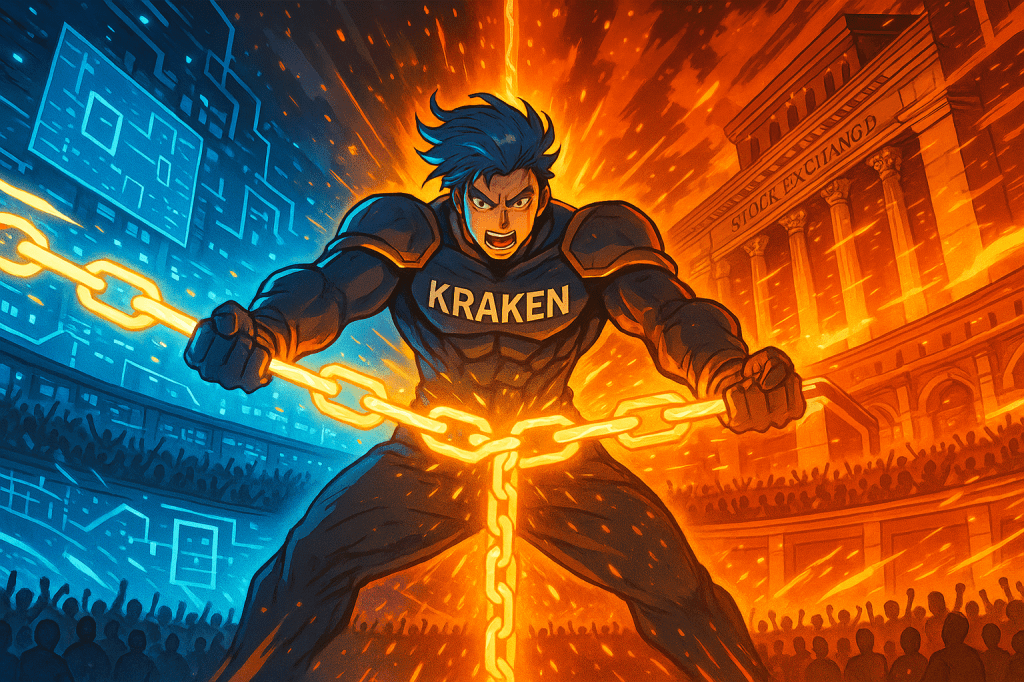
Kraken, one of the leading U.S.-based crypto exchanges, is expanding beyond digital assets—giving traders access to a wide range of CME Group derivatives spanning equities, commodities, FX, and metals, according to a statement shared with The Block.
Through its regulated futures commission merchant, Kraken Derivatives US, the exchange will now connect users directly to CME-listed futures, marking a major step toward merging crypto-native platforms with traditional finance (TradFi).
Competing Across the Financial Spectrum
The move intensifies Kraken’s competition with platforms like Robinhood, which has been expanding into both traditional and tokenized assets. Both companies are actively building cross-asset infrastructures, including efforts to support tokenized equities outside the U.S.
This futures expansion comes on the heels of Kraken’s $1.5 billion acquisition of NinjaTrader earlier this year—the largest crypto-to-TradFi tie-up to date. The deal gave Kraken an immediate foothold in the U.S. retail futures market and signaled its intent to go beyond crypto.
What’s Now Available
Kraken users can now trade futures on:
- Equity indices: S&P 500, NASDAQ, Dow Jones
- Commodities: Gold, oil, silver, soybeans, rice, cattle
- Metals & energy: Copper, natural gas
- Foreign exchange: EUR, GBP, JPY, AUD
- Other CME markets: CBOT, NYMEX, COMEX products
Contracts will be priced competitively at 0.5 basis points, with special data access packages for retail and pro users. Kraken says these products are “designed for serious futures traders.”
A Step Toward 24/7 Finance?
It’s not yet confirmed whether Kraken’s offering will follow CME’s traditional 24/5 schedule or support round-the-clock access. However, CME CEO Terry Duffy recently hinted at full 24/7 crypto futures and options, suggesting that broader all-week markets may be on the horizon.
CME’s crypto derivatives platform hit a record in Q3, with 340,000 average daily contracts totaling $14.1 billion in notional volume. On Oct. 16, the exchange will also launch options on Solana (SOL) and XRP futures—an indication of rising institutional interest in altcoins.
What It Means
Kraken’s latest move is more than just a product update—it’s part of a broader trend where crypto exchanges are becoming cross-asset brokerages, competing with traditional platforms while maintaining their Web3 edge.
For traders, it means one app, multiple markets—from DeFi tokens to gold futures—all under a regulated, increasingly global platform.
Square Rolls Out Seamless Bitcoin Payments for U.S. Retailers

Square, the payments firm founded by Jack Dorsey, has launched a new platform aimed at helping U.S. merchants seamlessly accept Bitcoin payments and manage BTC wallets—a major push toward making “Bitcoin everyday money.”
The platform integrates directly with Square’s point-of-sale systems, allowing small businesses to:
- Accept Bitcoin as payment (launching Nov. 10)
- Auto-convert up to 50% of daily card sales into BTC
- Buy, sell, hold, or withdraw Bitcoin in a single dashboard
This launch marks a significant step forward in making Bitcoin a usable asset in day-to-day business operations—not just a speculative holding.
Key Features for Merchants
- Integrated Wallet: Merchants can manage all BTC activity directly from their Square dashboard.
- Automatic Conversions: Sellers can opt to automatically convert a portion of their fiat sales into BTC.
- No Processing Fees: Bitcoin payments will carry 0% processing fees through 2026. Starting January 1, 2027, a 1% fee will apply.
- U.S. Availability: Conversions are now live for sellers in eligible states (excluding New York), with payment support rolling out next month.
Why It Matters
According to Miles Suter, Square’s Head of Bitcoin Product, the goal is to remove friction and make Bitcoin payments as simple as traditional card transactions. The platform empowers small businesses with tools traditionally only available to large enterprises.
“We’re making Bitcoin payments as seamless as card payments,” said Suter. “Through Square and Cash App, we serve both sides of the counter… helping sellers future-proof their operations.”
By bridging payments and custody, Square positions itself as a critical player in helping small merchants adopt Bitcoin without needing new infrastructure or technical knowledge.
 Powerbuilding Digital